
Top Signs You Need Air Duct Cleaning Service – Don’t Ignore These
The signs you actually need air duct cleaning service are specific: visible debris blowing from supply registers, confirmed mold growth inside metal ductwork, drywall dust after renovation, rodent or insect evidence in the ducts, a musty odor that moves with the HVAC cycle, or measurably degraded airflow that persists after a filter change. Most other “warning signs” floating around the internet trace back to a different problem entirely, like an undersized filter or a leaky return. If you’d rather not spend your Saturday with a flashlight and a screwdriver, call (361) 326-5060 and we’ll do the assessment for you.
Dust on your supply registers doesn’t mean your ducts are dirty. It often means your filter is undersized or installed backward, and cleaning the ducts won’t fix it. What follows is the honest breakdown of what actually signals duct cleaning versus what signals a filter upgrade, a sealed-duct pressure test, or an HVAC repair call. We’d rather you spend money on the right fix the first time.
Sign One: Visible Debris Blowing From Supply Registers
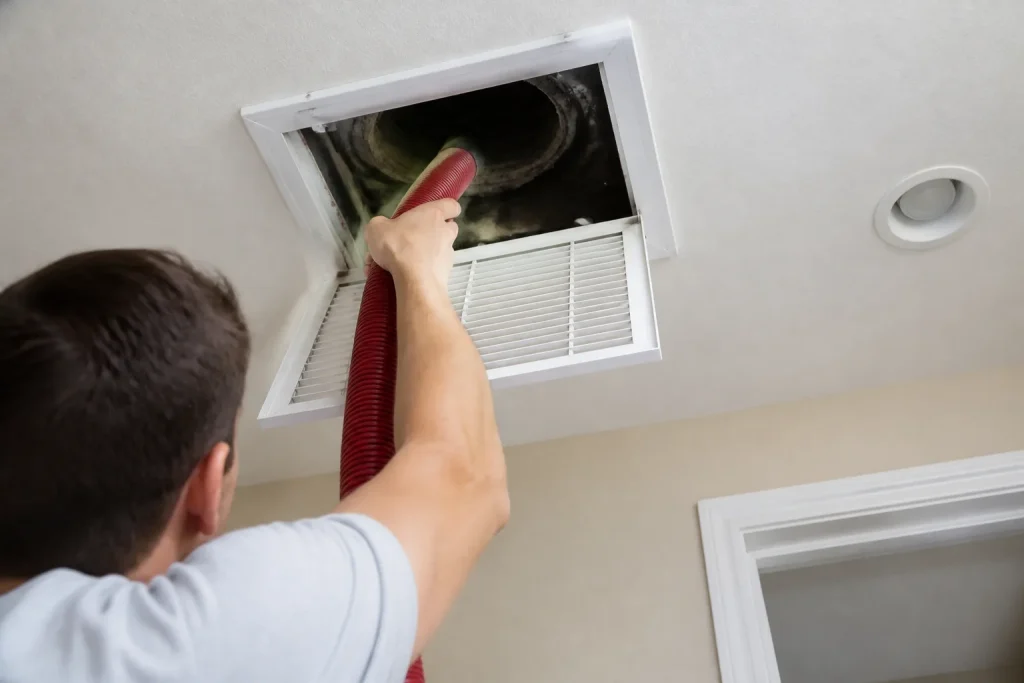
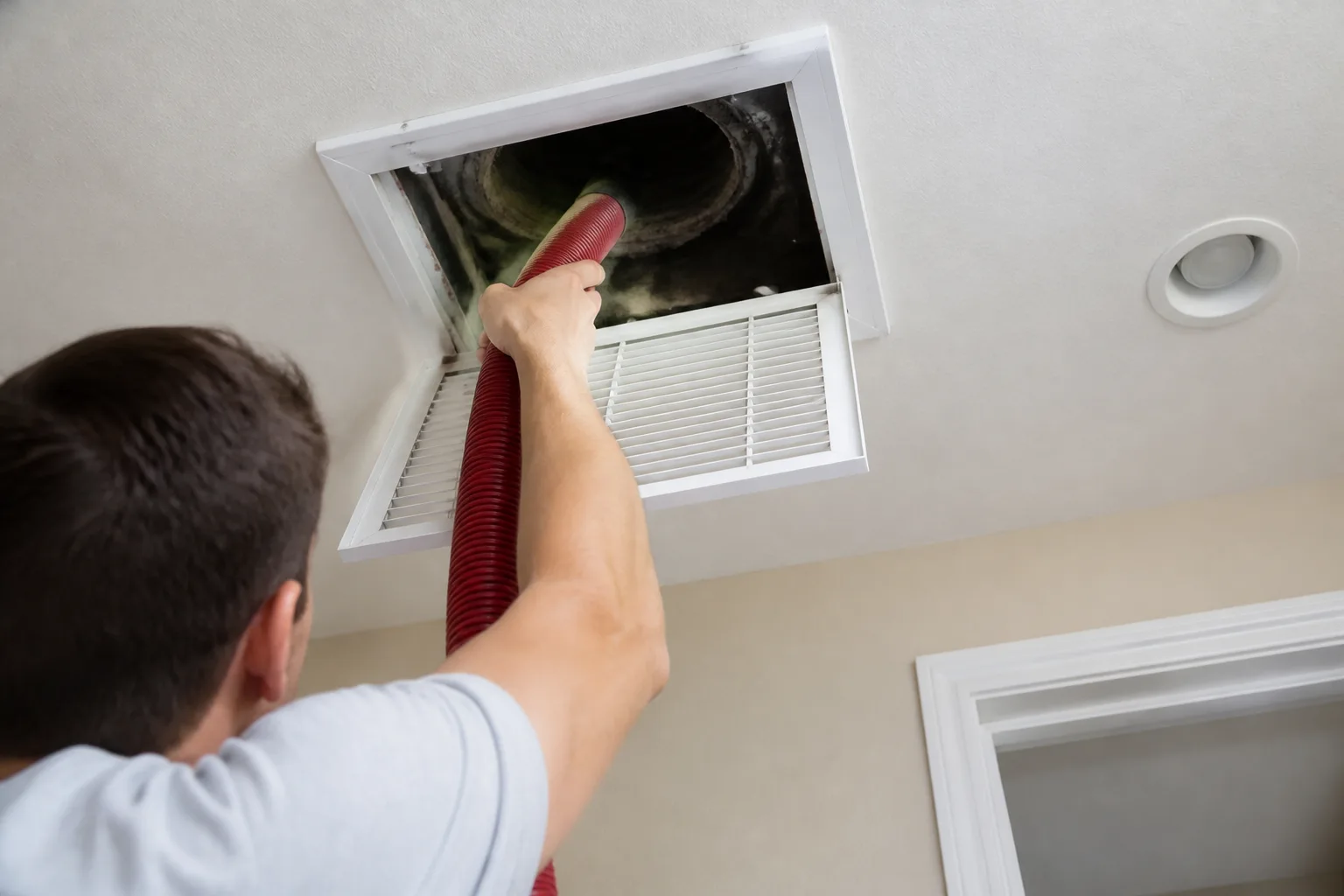
This is the clearest, least debatable sign. If you see puffs of dust, lint, or particles actively blowing out of a supply register when the system kicks on, the air stream is picking up debris somewhere between the air handler and the register grille. That somewhere is usually the ductwork itself. In Los Angeles, this shows up most often in older stucco homes where original flex duct has degraded internally. The plastic liner inside flex duct breaks down over 15 to 20 years, and the air stream carries those fragments straight into the room. No amount of register vacuuming fixes that. The debris is upstream, and the fix is mechanical removal from the duct interior.
A quick test: place a clean white cloth over a supply register for 10 minutes while the system runs. If the cloth comes away with visible gray or brown particulate, you have confirmed particle transport through the duct system. That warrants a professional assessment. If the cloth stays clean but dust accumulates on furniture near the register over days, the issue is more likely a filter bypass or a return-side leak pulling attic air into the system.
Sign Two: Confirmed Mold Growth Inside Metal Ductwork
Mold is the one sign where you should not guess, and you should not wait. But here’s what most blog posts won’t tell you: not all dark staining inside ducts is mold. Dust accumulation, soot, and even UV degradation of the mastic used at duct joints can look like mold to an untrained eye. Confirmed mold growth requires visual identification of raised, fuzzy, or slimy colony structures, and ideally surface sampling with a lab analysis.
In Los Angeles, the conditions that create mold inside ducts are specific. Our coastal neighborhoods and older hillside homes with poor drainage see elevated indoor humidity during June Gloom and winter rain seasons. When warm, moist air moves through an uninsulated duct run in a cold crawlspace, condensation forms on the interior surface. That moisture, combined with organic dust that’s already present, creates the food source mold needs. We see this pattern repeatedly in homes from the 1960s and 1970s in neighborhoods like Westchester and Culver City, where original sheet-metal duct runs through uninsulated crawlspaces.
If you suspect mold, the next step is not duct cleaning. It’s confirmation and source correction. A reputable company should identify the moisture source first, because cleaning mold out of a duct that’s going to re-condensate in three months is a waste of your money. Expect that conversation in the first 15 minutes of any legitimate assessment.
Sign Three: Renovation Dust Throughout the System
If you’ve recently remodeled a kitchen, gutted a bathroom, or had any drywall work done in your Los Angeles home, the fine dust generated during construction has almost certainly found its way into your duct system. Drywall dust is extremely fine, alkaline, and abrasive. It doesn’t just settle harmlessly. It coats the blower motor, clogs evaporator coils over time, and recirculates through your living space for months after the contractor has left.
This is the one scenario where we say: schedule the duct cleaning. Not because of marketing, but because drywall dust is a known mechanical problem for HVAC equipment. The dust that settles on the blower fan blades throws the wheel out of balance, which wears bearings prematurely. The dust that coats the evaporator coil acts as insulation, reducing heat exchange efficiency. The dust that stays suspended in the duct system keeps blowing back into the rooms you just renovated.
The professional-grade approach to this uses negative-air equipment, like the Nikro machines we run, to pull the entire duct system under vacuum while a rotary brush mechanically agitates the interior surfaces. The dust doesn’t get pushed around the house; it gets drawn out through a HEPA-filtered collection system. If you’ve just spent $40,000 on a remodel, the $400 to $600 for a proper whole-system duct cleaning in Los Angeles is the cheapest insurance you’ll buy that month.
Sign Four: Evidence of Rodents or Insects in the Ductwork
We pulled a rat carcass out of a duct run in a Pasadena bungalow last year that had been there long enough to mummify. The homeowner called about a smell that she described as “old attic” and couldn’t pinpoint. The odor moved room to room when the AC ran. The culprit was in the return duct, which had a one-inch gap at a joint where the original tape had failed and a rat had climbed in.
Vermin evidence is a legitimate, no-debate reason to have your ducts professionally cleaned. Rodents leave droppings, urine, nesting material, and eventually carcasses. Their presence introduces biological contamination that belongs nowhere near air you breathe. Insect evidence, especially cockroach frass and egg casings, signals the same truth: your duct system has openings that shouldn’t be there, and those openings are admitting pests from the attic, crawlspace, or wall cavities.
Here’s the part most companies gloss over: cleaning alone doesn’t solve this. The duct cleaning removes the contamination. But if the penetration points remain, the problem returns. Any honest assessment should include an inspection of the duct runs for failed connections, gaps at boots, and torn flex liner. That’s why duct sealing in Los Angeles goes hand-in-hand with cleaning in this scenario. You remove the hazard, then you close the door. We use mastic and aluminum tape rated for HVAC systems, not the gray plastic tape that dries out and fails in two years.
Sign Five: A Musty Odor That Moves With the HVAC Cycle
Here’s the diagnostic question that separates duct odor from every other kind of household odor: does the smell appear only when the system runs, and does it move from room to room with the airflow? If the answer to both is yes, the odor source is inside the duct path. If the smell is constant in one room regardless of whether the system is on, you’re looking at carpet, drywall, or a plumbing issue. Duct cleaning is not your answer in that case, and any company that tells you otherwise is guessing with your money.
A musty odor that activates with the blower often traces to one of three things: mold or mildew inside the ductwork, accumulated organic debris that has absorbed moisture, or a dead animal. The fix is assessment first, then mechanical cleaning if the source is confirmed in the ducts. This is where the assessment really matters. A technician should be able to open a section of duct, inspect with a borescope camera, and show you what’s actually in there. If a company quotes you over the phone without ever seeing the duct interior, the price isn’t based on your condition. Expect better.
Sign Six: Measurably Degraded Airflow
Weak airflow is the most commonly misattributed symptom in the entire HVAC world. Dirty ducts can cause reduced airflow, absolutely. But so can a clogged filter, a failing blower motor capacitor, a frozen evaporator coil, closed dampers, or a return that’s too small for the system. If you’re feeling weak airflow from half your registers, the odds are much higher that the problem is mechanical or filter-related than that your ducts are packed with enough debris to restrict flow.
Here’s how to narrow it down before calling anyone. First, check your filter. If it’s caked with visible gray fuzz, replace it and re-test airflow at the registers in 24 hours. If flow improves, you solved your problem for $15. Second, remove a register grille and look into the boot with a flashlight. If you can see visible accumulation on the duct walls more than a light dust coating, you’ve found evidence worth cleaning. Third, if airflow is weak in only one or two rooms, feel for a damper handle on the supply branch. Los Angeles homes with original duct design often have manual balancing dampers that get bumped or closed during renovations. A five-second adjustment fixes what a $600 duct cleaning won’t.
If airflow is weak everywhere, the filter is clean, and the air handler sounds like it’s working harder than it used to, then your duct system is a legitimate suspect. But be honest with yourself about the diagnostic order. The cheapest and most likely fixes come first. That’s the disciplined way to approach it, and it’s the approach we teach our people under The Garrison Code: arrive inside the window, price in writing, and don’t sell a service the customer doesn’t need.
The Los Angeles Specifics: Santa Ana Winds, Wildfire Smoke, and Original Flex Duct
Los Angeles has three local factors that change the duct cleaning conversation and rarely get addressed in generic online guides. First, Santa Ana wind season, which typically runs from September through November, pushes fine particulate through every gap in a home’s envelope. That dust ends up in the duct system, especially in returns that pull from unconditioned spaces like attics and garages. Second, wildfire smoke infiltration, which has become an annual event in LA County, introduces charred organic particulate into duct interiors. That particulate is chemically different from household dust, and it adheres to duct walls more aggressively. Third, the region has a huge inventory of homes built between 1950 and 1985 with original flex duct that is now 40 to 70 years old. That material reaches the end of its service life and begins to shed internally.
If you’re in a Los Angeles neighborhood with older housing stock, the ROI on a whole-system duct inspection is strong. We commonly find flex duct in neighborhoods like Eagle Rock, Glassell Park, and the older parts of the San Fernando Valley that has collapsed internally, delaminated, or accumulated so much debris that the branch runs are effectively useless. In those cases, the answer is replacement of the affected runs, not cleaning. A disciplined company tells you that. A sales crew sells you the cleaning and the run fails six months later, which is exactly the kind of outcome that gives this industry its reputation.
What should a duct cleaning company do in the first 15 minutes of an assessment? Walk the system. Physically inspect the return register, open the air handler cabinet, check the filter, and camera-inspect at least one supply run and one return run before recommending anything. If a technician starts quoting you a price without doing any of that, you’re not getting an assessment. You’re getting a sales pitch. Hollis Air Duct Cleaning has been cleaning ducts in Los Angelesand our technicians are trained to show you the evidence on camera before you agree to spend a dollar. That’s not a marketing tactic. It’s the only way to price a job honestly.
When the Answer Is NOT Duct Cleaning
Let’s be direct about the cases where duct cleaning is the wrong fix. If the dust in your home is fine, gray, and lands evenly on flat surfaces, and the filter is clogged within 30 days, you almost certainly have a return-side leak pulling attic or crawlspace air into the system. The fix is duct sealing and possibly a return modification, not cleaning. If you have one room that never cools while the rest of the house is fine, the issue is more likely a balancing problem or a compromised branch run than uniform contamination. If you smell gas, hear grinding from the air handler, or see water pooling under the unit, you need an HVAC technician. Duct cleaning companies don’t fix refrigerant leaks, and any that claim to are outside their lane.
A filter upgrade is often the highest-value change a Los Angeles homeowner can make. If you’re running a fiberglass one-inch filter that costs $3, moving to a pleated MERV 8 or MERV 11 filter, depending on your system’s airflow capacity, reduces the particle load entering the ductwork in the first place. We recommend filtration products from Honeywell and Aprilaire on jobs where the homeowner is fighting allergy season or wildfire smoke. The conversation starts with air in, not air clean: reduce the load, and downstream problems shrink.
The point is this: a sign is only useful if it points to a cause. Dirty ducts are a real problem, but they’re one problem among several, and the worst thing you can do is pay $600 for a service that doesn’t address what’s actually wrong with your air. The best thing a duct cleaning company can do for you is to tell you the truth about which category you’re in. Hollis Air Duct Cleaning is part of the Garrison Partners family, and The Garrison Standard says it plainly: written prices, written guarantees, and the Done Right Promise on every job. If it’s not done right, we make it right, in writing, for a full year. That’s the standard we work to in every Los Angeles neighborhood we serve.
Key Takeaways
- Real signs: visible debris blowing from registers, confirmed mold, post-renovation dust, vermin evidence, HVAC-linked musty odor, and persistent weak airflow after filter replacement.
- Common misdiagnosis: dust near registers usually means filter bypass or return leaks, not dirty ducts.
- Mold requires confirmation: not all dark staining is mold. Source correction must happen before cleaning or you’ll pay twice.
- LA-specific triggers: Santa Ana winds, wildfire smoke, and 40- to 70-year-old flex duct all contribute to duct contamination in this market.
- Assessment first, always: a legitimate company camera-inspects the ducts and shows you the evidence before quoting a price.
The Bottom Line
The signs that actually justify air duct cleaning are specific and verifiable, not vague and fear-based. Debris blowing from registers, confirmed mold inside metal ductwork, renovation dust, vermin evidence, an odor that travels with airflow, and persistent airflow loss all point to the ducts. Dust on registers, weak airflow in one room, and a clogged filter all point somewhere else. The disciplined approach is diagnosis before service, and that’s a standard most companies in this trade aren’t willing to hold. If you’re in Los Angeles and you want an honest assessment of your duct system, Hollis Air Duct Cleaning offers free estimates. Call (361) 326-5060 and we’ll schedule a walkthrough. Related services in Los Angeles include dryer vent cleaning, which removes a leading cause of house fires, and duct sealing, which closes the gaps that let attic air and pests into your system in the first place.
Frequently Asked Questions
Look for visible debris blowing from supply registers, confirmed mold growth inside the ducts, drywall dust after renovation, pest evidence, an odor that moves with the HVAC system, or weak airflow that persists after a filter change. Any one of these warrants a professional camera inspection. Dust accumulation around registers alone does not indicate dirty ducts.
Mold grows inside ducts when moisture meets organic dust in an enclosed, low-light environment. In Los Angeles, the most common cause is condensation forming inside uninsulated duct runs in crawlspaces or attics during humid periods like June Gloom. A proper response addresses both the contamination and the moisture source, or the mold will return after cleaning.
Usually not. Dust on register grilles is often caused by a filter that’s undersized, installed backward, or allowing air to bypass around its edges. It can also indicate a return-side leak pulling unfiltered attic or crawlspace air into the system. Check the filter first, then assess whether the dust problem is widespread or localized before spending money on duct cleaning.
A whole-system air duct cleaning in Los Angeles typically ranges from $400 to $800 depending on the size of the home, the number of supply runs, and whether dryer vent cleaning or duct sealing is included. Be wary of quotes that come in far below that range, especially per-vent pricing that multiplies at the door. Insist on a written quote with a fixed price before any work begins. Call (361) 326-5060 for an exact quote. Estimates are free.
Written by the team at Hollis Air Duct Cleaning.
Need Air Duct Cleaning Help?
Call Hollis Air Duct Cleaning - licensed & insured, here with fast after-hours help in Los Angeles.
(361) 326-5060