
Spring Air Duct Cleaning Checklist for Los Angeles Homes
Spring air duct cleaning in Los Angeles is best scheduled between late March and early May, before daytime highs settle into the 80s and your AC starts pulling daily duty. The checklist below walks you through what to inspect yourself, what a legitimate cleaning appointment should include in writing, and how to use the spring window to get an honest condition report on your duct system before summer load exposes every restriction. If you’d rather skip the DIY inspection and have a trained eye look at it, call (361) 326-5060 for a free estimate.
We pulled a return grille off a wall over in Sherman Oaks a few springs back and found a felt layer of Santa Ana dust thick enough to write your name in. That homeowner had no idea anything was wrong because the system still moved air. It just moved less of it every month, and the AC worked harder to compensate.
That’s the point of a spring checklist. The problems you catch in April cost less than the ones that find you in August.
Why Spring Is the Right Season for Duct Cleaning in Los Angeles
Spring in Los Angeles means something specific: the furnace has been running on cool mornings since November, the Santa Anas have been blowing dust and fine particulate into every return path since fall, and the AC hasn’t been asked to work hard yet. That combination creates a practical window. The system is accessible, the weather is mild enough to have the blower off during service, and any repair or sealing work can be completed before the first real heat wave hits.
If your ducts need attention and you wait until July to call, you’re scheduling into peak-demand season. Companies are stretched, response times lengthen, and the one time you need your AC at full capacity is also when it’s most likely to underperform from restricted airflow. We see it every year in Los Angeles. The smart homeowners book in April, get a written condition report, and have options in May. The reactive homeowners call in mid-July, when every reputable company in the Valley and the basin is booked solid.
There’s also a ventilation reality here that gets overlooked. Los Angeles homes run their HVAC differently than homes in, say, Chicago. We don’t have a true furnace season in the same way, but our systems can cycle year-round in some neighborhoods, especially places like Woodland Hills or Pasadena where winter mornings dip into the 40s and summer afternoons push 100. The more cycles, the more dust loading. Spring is when you reset that load before the heaviest demand months arrive.
The Spring Duct Cleaning Checklist: 5 Things Every Los Angeles Homeowner Should Check
Here’s a direct, workable list. None of these steps require special tools, and each one gives you a signal about whether your system needs attention.
1. Check Your Filter First
Look at your filter before you look anywhere else. If it’s a standard 1-inch filter and it’s been in place since before the holidays, it’s already overloaded. A clogged filter is not a duct problem, but it creates one: restricted airflow pulls more dust into the return path and forces the blower to work against resistance. In Los Angeles, where fine dust and pollen are constant, most 1-inch filters need replacement every 60 to 90 days. Hold the filter up to a light. If you can’t see light through it, replace it before evaluating anything else.
2. Inspect Supply Registers for Dust Streaking
Look at the vents where air blows out. Not just for dust on the louvers, which is normal. Look for streaking or discoloration on the wall or ceiling around the register. Dark streaks radiating outward from a supply vent often indicate that fine particulate is bypassing the filter and being deposited as air exits. This pattern, common in Los Angeles homes near busy boulevards, suggests the duct interior has accumulated enough debris to matter.
3. Look Inside Return Grilles
Remove one or two return grilles, usually the larger vent covers on walls or ceilings, and look inside. Use your phone’s flashlight. You’re looking for gray felt-like buildup on the duct surfaces, visible dust bunnies, or any sign of construction debris. In Los Angeles, return ducts in homes built before 1990 may still have original duct board or metal that has never been fully cleaned. If the return path is loaded, the whole system is working harder than it should.
4. Check for Pest Activity That Winter Concealed
Rodents and insects move into ductwork during cooler months because the system provides shelter and warmth. By spring, their presence may be evident at registers: droppings, nesting material, or a musty smell when the blower first kicks on. This is more common in Los Angeles neighborhoods with older housing stock, crawl spaces, or nearby open land, like parts of Atwater Village, Eagle Rock, or the hillside communities. If you see any sign of pest activity at a register, don’t just vacuum the visible area. The source is inside the duct run, and it requires a professional cleaning with proper containment.
5. Walk the Visible Ductwork if You Have Access
If you have a crawl space or basement where duct runs are visible, take a look. Check for sagging sections, separated joints, or disconnected runs. Check for signs of moisture, staining, or condensation. In Los Angeles, post-rain mold risk in crawl space ductwork is real, especially after the atmospheric river events we’ve had in recent years. If you see dark staining on the exterior of flex duct or around joints, there may be moisture intrusion that needs to be addressed before it becomes an indoor air quality problem.
What a Legitimate Spring Cleaning Appointment Should Include in Writing
Not all duct cleaning is created equal, and in Los Angeles the range of quality is wide. Here’s what a reputable spring appointment should include in scope before work begins, and what it should deliver in writing after work is done.
- Written price before any work starts. The price should be for the entire duct system, not per vent. Per-vent pricing is how bait-and-switch operations in this industry create a low teaser number that becomes a much larger invoice once the technician is in your home. Ask for one flat price per system, in writing, before work begins.
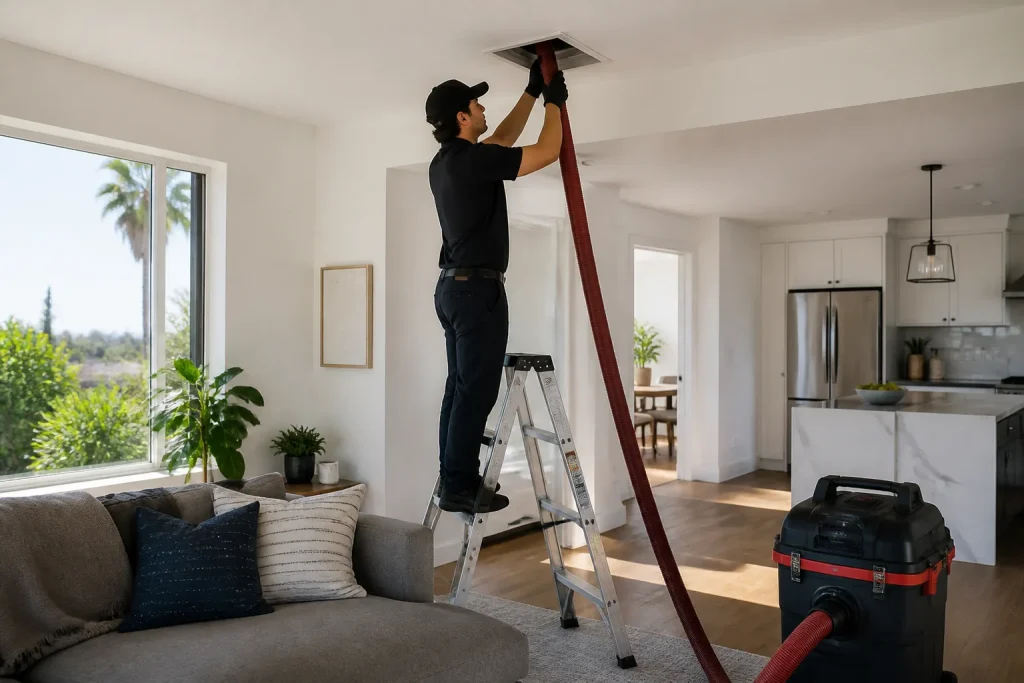
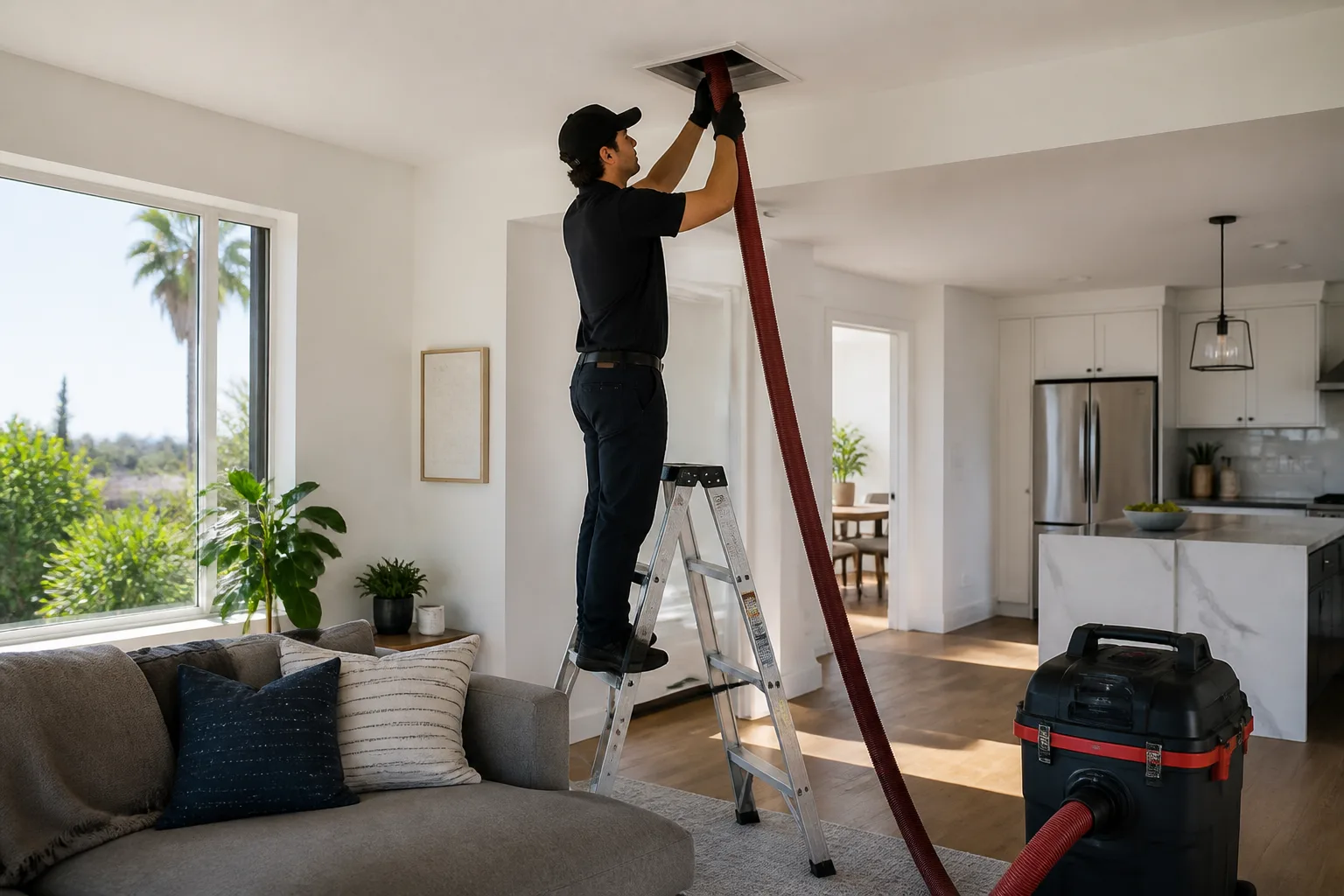
- Source removal, not just brushing. The industry term is negative-air cleaning. A powerful vacuum is connected to the duct system to create negative pressure, then rotary brushes or air whips dislodge debris from duct walls. The debris is drawn into the vacuum and contained. We run Rotobrush rotary brush systems and Nikro negative-air machines on our Los Angeles jobs because that combination does source removal properly. The plain-English version: the dust leaves your house, it doesn’t just get loosened and re-deposited.
- A post-job condition report. You should receive documentation of what was found and what was done. Not a vague one-page checklist with boxes ticked. A real report notes the condition of the duct interior, any moisture or damage found, and whether sealing or repair is recommended.
- Before-and-after photos. Any company doing this work properly photographs the duct interior. These photos are your proof that the work was actually done, not just claimed. If a company won’t provide them, ask why.
- A written guarantee. The work should be covered in writing. Our 365-Day Done Right Promise states that if the work fails within a year, we return and make it right at no charge, including a free second visit. Get whatever guarantee you’re offered on paper before you sign anything.
If you’re comparing quotes in Los Angeles and one is dramatically cheaper than another, ask what’s being omitted. Is it source removal or just surface brushing? Is containment included? Is the blower being pulled and cleaned? The cheapest quote is often not for the same job.
Spring-Specific Los Angeles Factors: Santa Ana Dust and Post-Rain Mold
Los Angeles has two seasonal forces that affect duct interiors more than most homeowners realize.
The first is Santa Ana wind season, which typically runs from September through March, with peak events in October through January. Santa Anas carry fine particulate from the deserts through the passes and into the basin. That dust doesn’t just land on your patio furniture. It gets drawn into return air paths, especially in homes with continuously running fans or systems that cycle frequently. By spring, the accumulation is often visible at returns even in homes that were cleaned the previous fall.
The second is post-rain moisture. Los Angeles gets most of its rain between December and March. Homes with crawl spaces, which include a large share of the mid-century housing stock in the San Fernando Valley and Westside neighborhoods, can develop elevated humidity underneath the house after sustained rain. Flex duct in crawl spaces absorbs that ambient moisture or can develop condensation on its exterior. Once moisture is present, mold risk follows. A spring duct inspection is the right time to catch this because the wet season has just ended and any impact is visible.
If you see dark staining at a supply register, a musty smell that worsens when the system runs, or visible mold on flexible duct in a crawl space, don’t run the system and hope it dries out. That just moves spores through the house. Get an assessment from a company that does source removal and has the right containment equipment.
How to Use the Spring Appointment to Plan Summer Repairs
Most homeowners think of duct cleaning as a one-time event. The smarter way to use the spring appointment is to treat it as a system inspection that includes cleaning. Here’s the sequence we recommend to Los Angeles homeowners.
Have the ducts cleaned and a written condition report produced in April or early May. The report should note any separated joints, damaged flex, or gaps in the duct network. Those gaps matter more in summer than winter because air-conditioned air is denser and under different pressure than heated air, so leaks at joints lose more conditioned air. A gap that didn’t seem important in February becomes a real loss in August.
If the report identifies leakage or damage, you then have time to schedule duct sealing or repair before peak cooling season. Duct sealing uses mastic, a thick, paste-like sealant applied to joints and seams, to close those gaps permanently. The plain-English version: you stop losing cooled air into your attic or crawl space. For homes in Encino, Tarzana, or other Valley neighborhoods where summer attic temperatures can reach 130 degrees or more, sealed ducts are the difference between an AC that holds temperature and one that runs constantly and still struggles.
The other decision the report helps you make is whether any duct runs need replacement rather than cleaning. Collapsed flex duct, pest-damaged sections, or runs that have pulled loose can’t be fixed with cleaning. Knowing in May gives you time to plan the repair before the July rush. Knowing in July means waiting in a hot house.
If the inspection turns up moisture damage from the rainy season, your spring report gives you a documented baseline for deciding whether a duct sealing job or just thorough cleaning is the right next step.
DIY Checklist vs. Professional Assessment: Where the Line Is
You can and should do the visual checks described above. Filter inspection, register condition, visible debris at returns, and a crawl space walk-through if you have access. Those checks tell you whether there’s a problem worth acting on.
But there’s a line where DIY stops being productive. You cannot clean the interior of duct runs without professional equipment. A shop vacuum with a hose will not reach more than a few feet into a duct run. Brushing what you can reach at a register will not remove debris deeper in the system, and in some cases, it can dislodge material that then moves further into the run or into the blower.
You also cannot properly assess mold or pest activity inside ducts without seeing the interior. If you see evidence at the registers, the source is further in. If you see moisture staining in the crawl space, the duct interior may have a problem that isn’t visible from the outside. Those findings warrant a professional assessment with proper inspection tools.
One honest note from the field: we sometimes get calls from Los Angeles homeowners who tried a “duct cleaning special” from a company that spent 45 minutes in the home and produced no documentation. Then they call us for the real job. The special cost them money, and they still need the work done. A legitimate cleaning on a typical single-family Los Angeles home takes several hours and includes containment, source removal, and documentation. If someone quotes a price and timeframe that don’t line up with that, something is missing from the scope.
The Bottom Line
Spring is the logical season for air duct cleaning in Los Angeles because it sits between furnace use and summer AC load. It’s the window when your system is easiest to access, least in demand, and any repairs can be completed before you actually need the cooling. The checklist is simple: check the filter, inspect supply registers for streaking, look inside return grilles for buildup, check for pest activity, and walk any visible ductwork for moisture or damage.
If you’re in Los Angeles and want a professional assessment, Hollis Air Duct Cleaning offers free estimates. We’ve been doing this work in Los Angeles since 2004, every job gets a written price before any work starts, and every cleaning is backed by our 365-Day Done Right Promise. Call (361) 326-5060 to schedule a spring assessment or just to ask questions about what you’re seeing at your registers.
Frequently Asked Questions
For a typical single-family home in Los Angeles, whole-system air duct cleaning generally runs between $350 and $650, depending on the number of systems, the size of the home, and whether there are access challenges like narrow crawl spaces or rooftop units. A home with two HVAC systems will cost more than a single-system home. Beware of per-vent quotes that start low and multiply. Ask for one flat price per system, in writing, before work starts. Call (361) 326-5060 for an exact quote on your Los Angeles home. Estimates are free.
The cheaper quote is usually not for the same job. Low prices in the duct cleaning industry often mean surface brushing instead of source removal, no containment, no blower cleaning, and no documentation. Some companies use the low price to get a technician in the door, then upsell. A legitimate negative-air cleaning with rotary brush agitation takes several hours and requires real equipment. If a quote is half what every other reputable company in Los Angeles is charging, ask what’s being left out.
Ask for before-and-after photos of the duct interior. Any company doing proper source removal photographs the work. You should also receive a written condition report noting what was found, what was cleaned, and any recommendations for sealing or repair. If a company cannot provide photographic proof and a written report, that’s a red flag. At Hollis Air Duct Cleaning, every job in Los Angeles includes photos and a written report, and the work is covered by our 365-Day Done Right Promise.
For most Los Angeles homes, every three to five years is a reasonable interval. Homes with pets that shed, residents with allergies or asthma, or locations near busy roadways or construction may benefit from more frequent cleaning, every two to three years. Homes that went through renovation without proper duct protection should be cleaned immediately after the work is complete. If you’ve never had your ducts cleaned and the home is more than 10 years old, assume they need it now. Call (361) 326-5060 for a free assessment.
No. A shop vacuum cannot reach more than a few feet into a duct run, and brushing what you can reach at the register can push debris deeper into the system or toward the blower. Proper cleaning requires negative-air containment equipment and rotary agitation tools that reach the full length of each run. If you’ve spotted debris at a register, that indicates buildup deeper in the system. A professional assessment is the right next step.
For more on what a complete cleaning involves, see our air duct cleaning in Los Angeles page. If you’re also noticing lint buildup or slow dryer cycles, our dryer vent cleaning service covers that as well. You can also learn more about Hollis Air Duct Cleaning home and the standards we hold on every job.
Written by Roy Castellanos, Owner at Hollis Air Duct Cleaning, serving Los Angeles since 2004.
Need Air Duct Cleaning Help?
Call Hollis Air Duct Cleaning - licensed & insured, here with fast after-hours help in Los Angeles.
(361) 326-5060