
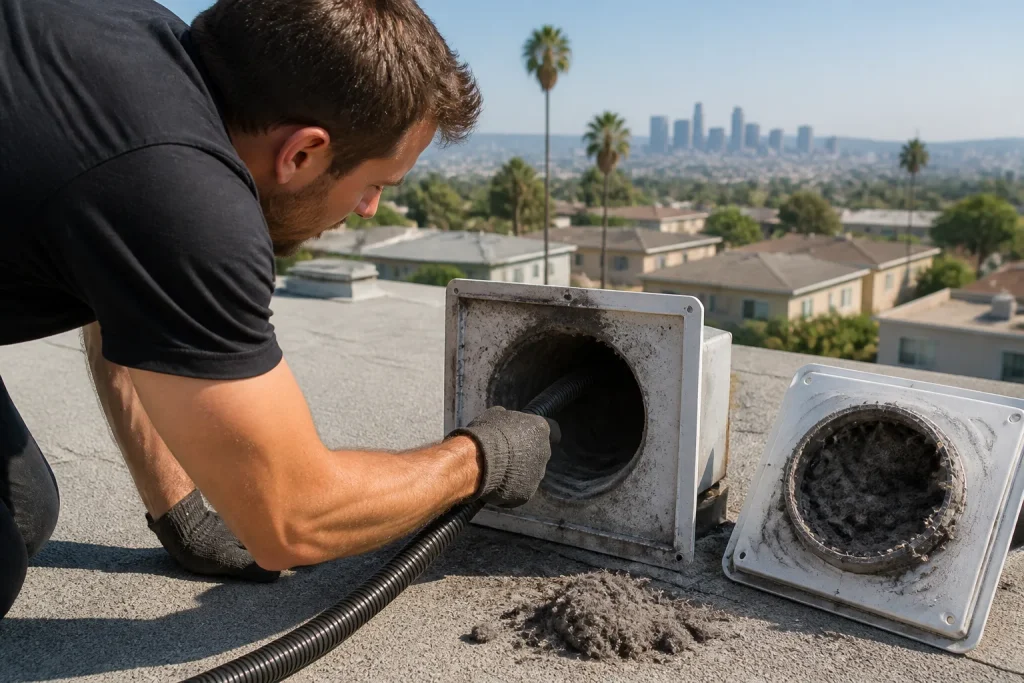
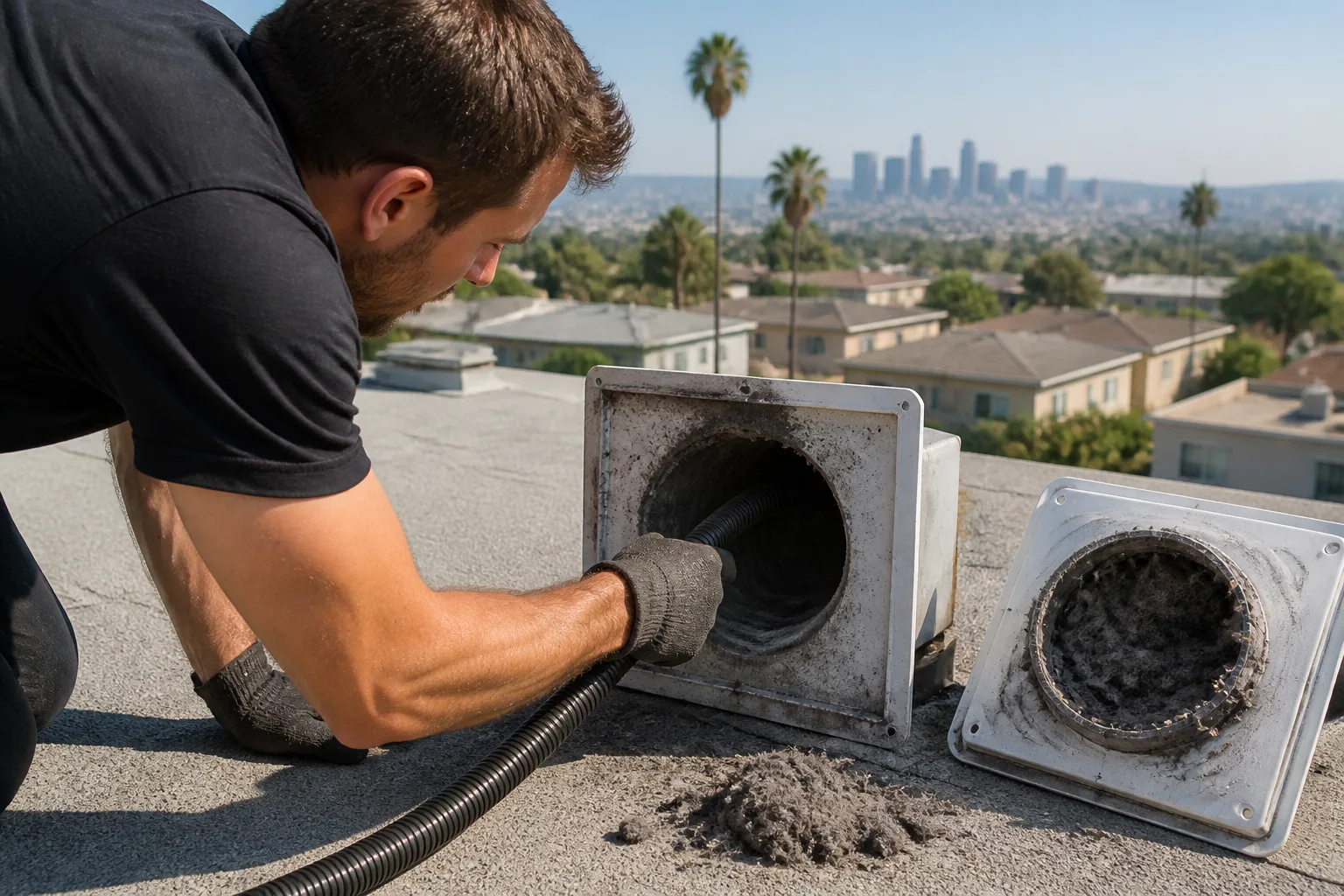
Dryer Vent Cleaning: Repair or Replace? How Los Angeles Homeowners Decide
If your dryer vent needs attention, the honest answer is that most Los Angeles homes need a cleaning, not a replacement – but a meaningful minority have vents that cleaning won’t save because they were never installed to code in the first place. The U.S. Fire Administration attributes roughly 2,900 dryer fires per year to failure to clean, yet the vents most likely to burn aren’t just dirty; they’re also too long, kinked, or venting into a wall cavity instead of the exterior. Here’s how to tell which situation you’re in, what each fix costs in LA, and when a repair or reroute beats another cleaning.
If you’d rather not sort this out yourself, call (361) 326-5060 for a free estimate. We’ll assess the vent and give you our recommendation in writing before any work starts.
First, know your vent’s maximum legal length
The International Residential Code (IRC), which California adopts with local amendments, caps dryer exhaust duct length at 25 feet equivalent. That’s the key word: equivalent. Each 90-degree elbow adds 5 feet to your effective run because it slows airflow and creates a trap point for lint. A 45-degree elbow adds 2.5 feet.
Most Los Angeles homeowners are stunned when they measure. A dryer in a laundry room on an interior wall, routed up and across a ceiling to reach an exterior wall 15 feet away, with two elbows along the way, is already at 25 feet equivalent before you account for the flex connector behind the dryer. Add a third elbow and you’re over. The IRC doesn’t allow it, and no cleaning schedule fixes the physics: a run that long simply cannot maintain the air velocity needed to push lint all the way out. Lint deposits, airflow drops, heat builds up, and eventually the vent becomes a fire hazard that cleaning only temporarily bandages.
How to measure yours: run a tape measure along the actual path of the duct from the dryer’s exhaust port to the exterior termination. Count every elbow. Multiply 90s by 5 and 45s by 2.5, add that to your measured distance, and the total is your equivalent feet. If you’re under 25, a proper cleaning usually solves most problems. If you’re over 25, or anywhere close, the vent itself is the problem – and in Los Angeles, where mid-century homes often put laundry rooms in windowless interior hallways, over-limit runs are more common than not.
Three failure modes cleaning alone won’t fix
We’ve assessed thousands of dryer vents across Los Angeles – from stucco tract homes in the Valley to stacked-unit condos in Koreatown and Mar Vista. When a vent fails, it usually fails one of three ways, and a cleaning crew that pockets your money without telling you is doing you no favors.
1. Crushed flex duct behind the dryer
A dryer shoved against the wall kinks the foil or semi-rigid transition duct behind it. That kink can cut airflow by half or more, and no amount of cleaning upstream or downstream restores that pinch point. In our experience, this is the single most common repair-or-replace trigger in Los Angeles, because laundry closets here are tight – often 30 inches of space with a 27-inch dryer jammed in. You can check this yourself: pull the dryer out gently and look at the connector. If it’s accordioned, crush-flattened, or torn, it needs replacement, not cleaning. A new UL-listed semi-rigid metal connector costs between $15 and $40 in parts, and it’s a $150 to $250 repair when a technician does it right.
2. Foil accordion duct that’s collapsed over time
Older Los Angeles homes, especially those built before the 1990s, frequently have the original foil accordion flex duct running the full length of the vent. Foil was never code-legal for the full run – it’s only permitted for the short connector at the dryer – but thousands of LA homes have it because it was cheap and quick to pull. Over two decades of heat cycling, that foil sags, tears from the inside, and traps lint in its ridges like a file. Cleaning a foil run actually makes it worse sometimes, because the brush catches and shreds the material. If your vent is foil from end to end, replacement with rigid 4-inch metal pipe is the only permanent fix, and in our opinion, any company that cleans it instead and calls it done should explain why they want you calling them back every year.
3. Termination in an attic, crawlspace, or wall cavity
This one makes us angry when we see it. In Los Angeles, we find vents that dead-end into attics, blown insulation, raised crawlspaces, and even interior wall cavities. The builder or a previous homeowner ran the duct to the nearest opening and stopped, venting hot, humid, lint-laden air into the house’s envelope. Every load of laundry pumps moisture into that space. In an LA attic, that moisture and lint sit up there and do exactly what you’d expect in a warm, dry space: they become kindling. Cleaning doesn’t address this at all – the vent must be rerouted to an exterior wall or roof cap to be safe, period. If you’re not sure where your vent exits, check where the duct leaves your laundry area and see if you can find the corresponding cap on an exterior wall or roofline. If you can’t find it, that’s your answer, and you should call a pro this week, not next season.
What each fix actually costs in the Los Angeles market
We believe in telling Los Angeles homeowners the numbers up front so there are no surprises on the invoice. Here’s what you can expect to pay in LA, based on current market rates for licensed and insured contractors who do this work properly:
Dryer Vent Cleaning
A proper dryer vent cleaning in Los Angeles runs $110 to $190 for most single-family homes when done with a rotary brush and negative-air capture, not a drill-attached brush from the hardware store. Condos and apartments in high-rises with long shared-wall runs run $160 to $250 because the access is harder and the runs are longer. If someone quotes you $49, you’ll get a technician with a shop vac and a story about why the blower wheel needs replacing. The low price is the bait; the invoice is the switch. One flat price per vent, in writing before the work starts, is the only way you should do business.
New Transition Connector
The short flex or semi-rigid connector at the back of the dryer is separate from the main duct. Replacing a crushed or kinked connector with a UL-listed one costs $150 to $250 including labor in LA. It’s the cheapest repair that makes the biggest difference, and it should always be checked before you pay for a full cleaning.
Partial Reroute
If your vent is over length or takes a bad path, a partial reroute moves the termination point to a code-compliant exterior location. In Los Angeles, most single-family reroutes run $350 to $750 depending on the distance, the number of bends, and what’s in the wall. Stucco penetrations add $100 to $200 because cutting a clean 4-inch hole through stucco is a full trade job requiring a Diamond blade, proper flashing, and sealing to keep water out. If you’re in a stucco exterior home in neighborhoods from Eagle Rock to Sherman Oaks, factor that in.
Full Vent Replacement
Replacing the entire run with rigid 4-inch metal pipe and correcting the termination runs $450 to $900 in the LA market for most single-story homes. Second-story runs and flat-roof terminations with roof caps run $700 to $1,200. We pull old foil and flex out of homes in neighborhoods across the city where the run goes 30 to 60 feet with five elbows, and those jobs are at the top of the range. The good news: a rigid metal run, properly installed, rarely needs more than a once-a-year inspection and a light cleaning every one to two years depending on how much laundry you do.
Los Angeles installation quirks that change the answer
Every city builds differently, and Los Angeles has three specific conditions that affect the clean-versus-replace decision more than most homeowners realize.
High-rise and mid-rise condo runs
Downtown LA, Koreatown, Miracle Mile, and the Wilshire Corridor are full of stack-unit condos where the dryer vent runs through a shared wall from the fourth floor to a common roof stack. Those runs can be 40, 50, even 60 feet equivalent. They’re almost never cleaned by the building, and they’re rarely code-compliant to unit-level standards. If you live in one of these buildings, a cleaning helps with airflow in the short term but the run itself is a permanent restriction. Replacement means opening walls, which requires HOA approval and shared-cost negotiations. Clean it every year, document everything, and push your board to inspect the stack. If your building needs professional dryer vent cleaning in Los Angeles across multiple units, we coordinate with HOAs and give one written price for the whole property.
Stucco exterior homes
Most single-family homes in the San Fernando Valley, the Westside, and South LA are stucco exteriors. When a vent terminates poorly and you decide to reroute, someone has to cut through an inch of cement-based stucco, pull the lath if there is any, run the pipe, and flash the new cap properly. If that flashing fails, you get water intrusion through the stucco, and that’s a repair bill that makes a dryer vent look cheap. This is one reason we say always use a licensed contractor who carries liability insurance for this work – not a handyman with a hole saw.
Flat-roof homes
Los Angeles has tens of thousands of flat-roof houses from the mid-century building boom, concentrated in neighborhoods like Mar Vista, Westchester, and the Crenshaw district. Roof-exhaust dryer caps on flat roofs fail notoriously fast: standing water, LA sun, and our seasonal Santa Anas bake and crack the cap seal within a few years. When a roof cap fails, water follows the pipe down into the laundry area. If you have a flat-roof LA home and your dryer vent terminates vertically, have the cap checked every time you get your roof serviced. Replacement caps run $80 to $200 installed, and it’s a cheap insurance policy against a water-damage claim.
How Hollis assesses your vent before we recommend anything
We don’t run our business that way. Our assessment follows a fixed order, and you get the recommendation in writing before you authorize a dollar of work.
We start with airflow: a vane anemometer at the exterior termination tells us the CFM your dryer is actually achieving under load. If your dryer is rated for 150 CFM and you’re getting 45 CFM at the cap, we know there’s a restriction, and we go looking for it. We pull the dryer out and inspect the connector. We camera-scope the run from both ends. We measure equivalent length. We check the termination point. Only then do we tell you clean, repair, or replace – and why.
If it’s a clean, we use a rotary brush system from Rotobrush mated to a Nikro negative-air machine, same as the commercial crews use, so the lint we break loose is captured at the wall before it enters your laundry room. No blast-and-hope with a shop vac. If it’s a repair, the price is written down before the repair starts. If it’s a replace, the reroute plan is on paper with a diagram and a fixed number. When the job is done, every Hollis job is covered by the Done Right Promise: if it fails within a year, we return at no charge. That includes a free second visit. No fine print, no negotiation.
We also believe you should know who’s walking into your home. Our technicians are background-checked, uniformed, and arrive inside the quoted window – which we set when you call, and we answer the phone when you call. Live person, 24 hours a day, not a callback queue. When the job is finished, they leave the site the way they found it, which is part of The Garrison Standard that every Hollis location runs on.
When to call a pro: If your vent is over 25 feet equivalent, made of foil flex anywhere beyond the connector, terminates inside the building, or you haven’t seen the cap in two years. Also, if your dryer takes longer than 45 minutes to dry a normal load, the vent is talking to you. Listen.
If you need related work done, we also provide air duct cleaning in Los Angeles and duct sealing in Los Angeles, so the whole system in your home can be handled by one crew under one written standard.
The Bottom Line
The repair-or-replace question usually resolves with three measurements: calculate your equivalent duct length, pull out the dryer and look at the connector, and find where the vent actually terminates. If you’re under 25 feet equivalent, the connector looks clean, and the cap is on an exterior wall, a professional cleaning is the right call – and in Los Angeles, that’s $110 to $190 done right, not $49 done wrong. If you’re over length, on foil flex, or terminating indoors, cleaning is a recurring bandage, and replacement is the only fix that makes the system safe for good.
If you’re in Los Angeles and want an honest assessment from a crew that puts the recommendation in writing before you pay, call us at (361) 326-5060 for a free estimate. We’ll tell you whether you need a cleaning, a repair, or a reroute – and then you decide, based on facts and a price that doesn’t move at the door.
Frequently Asked Questions
In Los Angeles, a proper dryer vent cleaning with rotary brush and negative-air capture runs $110 to $190 for most single-family homes and $160 to $250 for condos or long-run systems. If a quote comes in far under that, check what equipment they’re using and whether the price will hold once they’re inside. Call (361) 326-5060 for a written estimate that doesn’t move at the door.
Three checks give the answer. First, measure your duct’s equivalent length (25 feet max, adding 5 feet per 90-degree elbow). Second, pull the dryer out and look for a crushed or kinked connector. Third, confirm the vent terminates outside, not in an attic or crawlspace. If you fail any of the three, repair or replacement is the better call. We can perform all three checks in one visit and give you the recommendation in writing.
Low quotes in the Los Angeles market usually mean a shop vac and a brush on a drill, no capture equipment, and an invoice that grows once the tech finds something to upsell. The vent gets a quick surface clean but the deepest lint in the run stays. A proper Los Angeles dryer vent cleaning uses rotary brushing paired with negative air so what you remove is actually captured. One flat price per vent, written before work, is the only number that means anything.
You can clear the lint screen and, if you’re able, move the dryer and vacuum what you can reach. For anything beyond that, especially on runs longer than a few feet or anything going up through a roof, we recommend a trained professional. Lint removal from long LA runs requires a rotary brush and negative air capture, and roof work on flat-roof homes carries a fall risk. We’d rather come do it safely than see you on a ladder you didn’t need to climb.
Before the tech leaves, ask to see the termination point: the cap on the exterior wall or roof should be visibly clear of lint and passing air. At Hollis, we show you the camera footage from inside the duct before and after, and we leave the area clean. You should never sign off on a cleaning you can’t verify. Our Done Right Promise means if the vent clogs again within a year, we come back at no charge – and the before-and-after proof of your own duct is part of every job.
Written by the team at Hollis Air Duct Cleaning.
Related services: Hollis Air Duct Cleaning home, Air Duct Cleaning in Los Angeles, Dryer Vent Cleaning in Los Angeles, and Duct Sealing in Los Angeles.
Need Air Duct Cleaning Help?
Call Hollis Air Duct Cleaning - licensed & insured, here with fast after-hours help in Los Angeles.
(361) 326-5060