
Abatement Technologies Air Duct Cleaning in Los Angeles: A Homeowner’s Guide
When you see “Abatement Technologies” attached to a duct cleaning service in Los Angeles, it’s not a cleaning method. It’s the name of a manufacturer that builds HEPA-rated negative air machines, duct cleaning equipment, and containment systems used on jobs where controlling what’s in the air is the entire point. Understanding what that equipment does, and when it’s actually needed, tells you more about a company’s capabilities than any coupon price ever will. If you’d rather skip the research and talk to someone who runs this equipment weekly, call (361) 326-5060 for a straight answer.
What Abatement Technologies Actually Makes (and Why It’s Not a Cleaning Method)
Abatement Technologies is not a duct cleaning franchise, and there’s no such thing as “Abatement Technologies duct cleaning” as a technique. The company manufactures negative air pressure machines, HEPA-filtered air scrubbers, and portable containment systems. These are the gray boxy units you might see outside a commercial water damage or remediation site, hoses running out a window or door. In a residential Los Angeles home, they typically don’t get used for a standard air duct cleaning. They come out when the job involves something beyond dust: visible mold, post-fire soot, heavy renovation debris, or vermin contamination in the ductwork.
The distinction matters because it’s easy for a company to name-drop a brand and let homeowners assume they’re getting something more than they are. A HEPA vacuum inlet on a truck-mounted unit is not the same thing as a HEPA-rated negative air machine creating containment in the work area. We run Rotobrush rotary brush systems for routine cleaning, Nikro negative air machines for extraction, and when a Los Angeles job calls for containment-grade air handling, equipment from manufacturers like Abatement Technologies is what gets deployed. The equipment follows the problem, not the brochure.
When HEPA-Level Containment Is the Right Call in Los Angeles
Most Los Angeles homes with dust, pet hair, and years of accumulated lint in the ductwork don’t need containment-level equipment. A properly run truck-mounted or portable negative air setup will remove the debris without spreading it through the living space. But Los Angeles has specific situations where the answer changes.
Post-renovation homes are a common one. When drywall dust, tile-cutting fines, and demolition particulate get pulled into return ducts and distributed through multiple rooms, standard cleaning removes the visible debris, but the finest fraction of that dust can linger and recirculate. Fire restoration is another. Homes that sat near a wildfire or dealt with an indoor fire have smoke particulates that behave differently from ordinary dust; they’re finer, oilier, and more persistent. And visible mold growth inside ductwork triggers a different protocol entirely. In those cases, a technician should be setting up a negative pressure environment with HEPA-filtered exhaust so that air from the work area doesn’t push into the rest of the home during cleaning. That’s what equipment like Abatement Technologies’ negative air machines does: it creates a pressure differential that keeps contaminants moving toward the filter, not toward your kitchen.
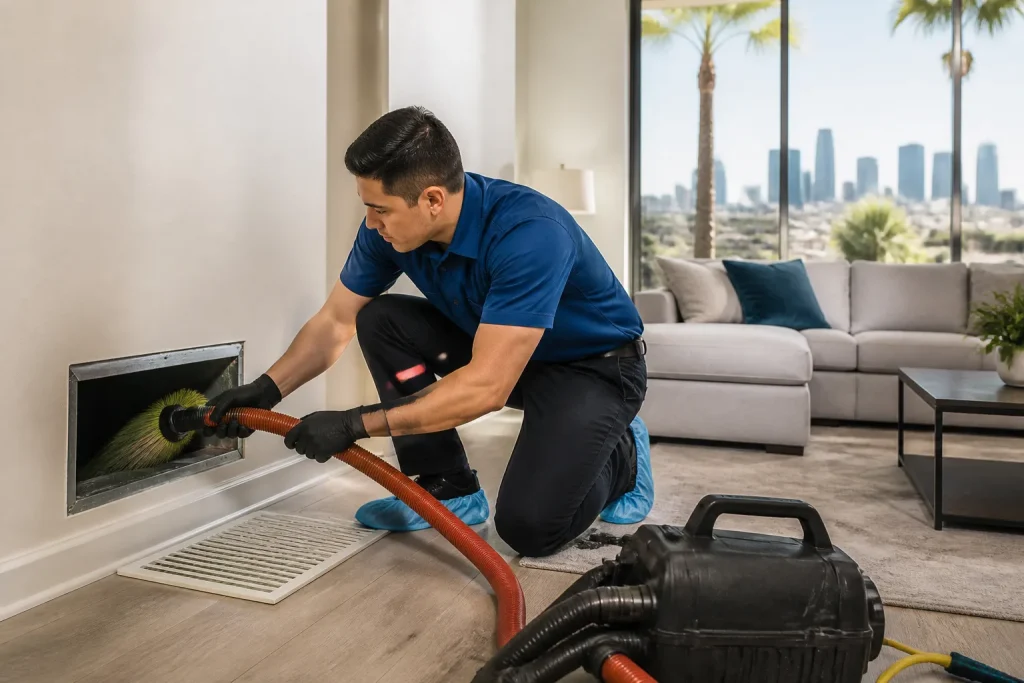
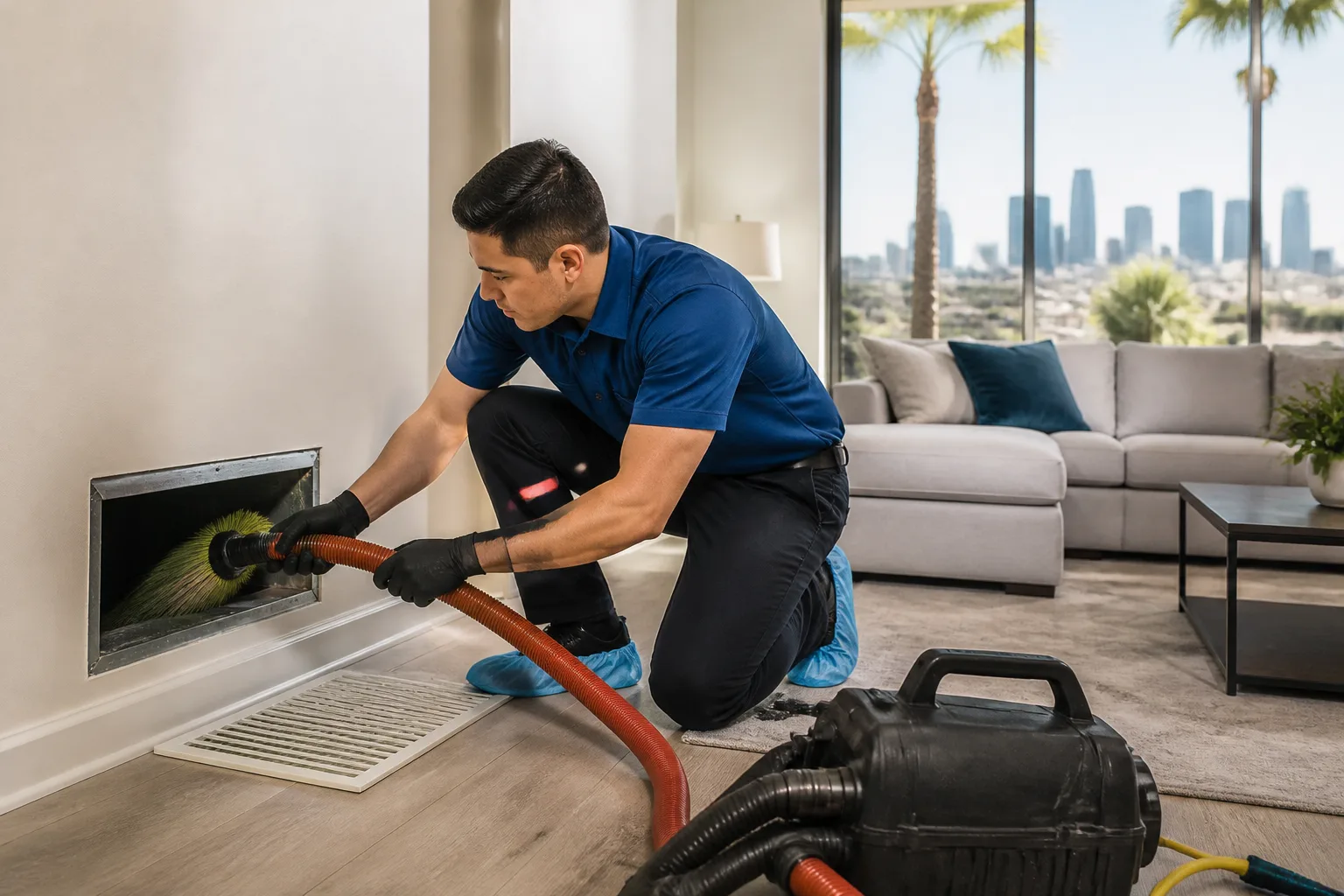
- Standard cleaning: rotary brush agitation plus a powerful extraction vacuum handles typical Los Angeles household dust and debris.
- Post-renovation or post-remodel: HEPA extraction on the vacuum side, with air washes to remove fine construction dust.
- Mold, fire, or heavy contamination: full negative air containment with HEPA-rated equipment, often in a sealed work zone.
What a Negative Air Pressure Setup Actually Looks Like in a Home
Here’s what you should see if a Los Angeles company tells you they’re using containment equipment on your job. First, a large flexible duct runs from the machine to a window or exterior door, sealed at the opening with a panel or adjustable frame. That duct carries filtered exhaust outside. Second, the machine itself is running continuously during the cleaning process, and the technician can tell you the air exchange rate if you ask. Third, if the job is large enough to warrant a full containment area, plastic sheeting seals off doorways or sections of the home, with the negative air machine pulling from that sealed zone.
You should be able to verify any of this by looking at the setup. A machine sitting in the corner with no exhaust duct to the outside is not doing negative air work. A HEPA filter label on a shop vac is not a containment system. If a company in Los Angeles claims to use “Abatement Technologies equipment” on your standard duct cleaning, ask one direct question: “Which unit are you using, and can you show me the exhaust setup?” A real technician will answer in ten seconds. A salesperson will get vague.
We pulled drywall dust out of a house over in Los Feliz last month where the homeowner had already paid another company for a “HEPA duct cleaning” that never hooked a single hose to a window. The receipt said HEPA. The setup did not match. That distinction is what separates companies that document their work from ones that document their marketing.
HEPA Filtration on the Vacuum vs. HEPA Containment of the Work Area
These are two different claims, and Los Angeles homeowners get them confused constantly. A HEPA filter on the vacuum unit means the air exiting that machine passes through a filter rated to capture 99.97% of particles at 0.3 microns. That’s a real filtration standard, and it matters, but it only tells you about the air the machine exhausts. It says nothing about the air circulating in the room while the cleaning happens.
HEPA containment of the work area, by contrast, means the room or zone itself is under negative pressure, so air moves from the rest of the home into the work area, then through the HEPA filter before it’s exhausted. Nothing from the work area drifts into the hallway, the living room, or the bedroom. If a job involves visible mold in a section of ductwork, HEPA filtration on the vacuum is insufficient without that pressure differential. The mold spores that get stirred up during cleaning need to be captured before they spread, not after.
When a Los Angeles home has a legitimate contamination scenario, we document exactly which setup was used: what machine, what filter rating, what the pressure differential was, and how waste was handled. That record belongs in your file, and here’s why it matters.
Why Equipment Documentation Matters for Insurance, Home Sales, and Remediation Records
Los Angeles is a city where real estate transactions move fast, insurance adjusters ask hard questions, and remediation history can affect a sale price. If your home undergoes a duct cleaning after a fire, a mold event, or a major renovation, the company should hand you a record of what was done and what equipment was used. Not a receipt that says “Duct Cleaning: Complete.” A real record.
Insurance claims sometimes hinge on whether proper remediation protocols were followed. A home sale might stall if a buyer asks about past moisture issues and you can’t produce documentation. And if you’re a landlord or property manager in Los Angeles, that paperwork protects you from disputes about whether maintenance was actually performed. We generate documentation on every job that involves containment. The equipment manufacturers, filter ratings, and process notes go in writing, because a year later, “we cleaned it” means nothing and a dated equipment log means everything.
This is also where the Done Right Promise comes in. If the job is documented and the equipment is named, and something fails within the year, we know exactly what was done and can make it right at no charge, including a free second visit. That’s not a marketing line. It’s the written standard on every job we run in Los Angeles.
How to Talk to Any Duct Cleaning Company About Equipment
You don’t need to become a technician to ask the right questions. Here’s what a Los Angeles homeowner should ask before scheduling:
- “What type of extraction equipment do you use?” If they say “truck-mounted” or “portable negative air,” that’s a real answer. If they repeat “we clean ducts,” that’s not.
- “Do you use HEPA filtration on the vacuum exhaust?” For standard cleaning, this is a reasonable expectation. If they don’t know, that’s a red flag.
- “For contamination work, do you set up negative air containment?” If they don’t know what that means, they’re not equipped for mold or fire restoration. Move on.
- “What documentation do I get afterward?” The answer should include equipment types and process notes, not just an invoice total.
If you’re in Los Angeles and want a crew that answers these questions precisely, our Air Duct Cleaning in Los Angeles page covers exactly how we run the equipment and what to expect. We also offer Dryer Vent Cleaning in Los Angeles and Duct Sealing in Los Angeles for the full picture of your home’s air system.
The Bottom Line
Abatement Technologies makes serious containment and air handling equipment, and in the right scenario, that equipment is irreplaceable. But a brand name wrap doesn’t clean your ducts. What matters is whether the company knows when containment is required, whether they set it up correctly, and whether they document it in writing. For most Los Angeles homes, a disciplined rotary brush cleaning with proper extraction is exactly right. For mold, fire, and heavy renovation debris, insist on a company that runs true negative air with HEPA-rated equipment and can show you the exhaust setup with their own hands.
If you’re in Los Angeles and need help figuring out which situation you’re in, Hollis Air Duct Cleaning home has the details, and we answer the phone live 24/7. Call (361) 326-5060 for a free estimate. The price gets written down before anything starts, and it doesn’t move at the door.
Frequently Asked Questions
No. Abatement Technologies is a manufacturer of HEPA-rated negative air machines, air scrubbers, and containment equipment, not a cleaning service. A duct cleaning company in Los Angeles may use their equipment for contamination work, but the brand itself does not clean ducts.
No. Standard residential duct cleaning in Los Angeles typically uses a rotary brush system and a powerful extraction vacuum. HEPA-level containment with negative air pressure is called for when the home has visible mold, post-fire soot, or heavy renovation debris in the ducts. For routine dust and debris removal, standard equipment does the job correctly.
Look at the setup. A negative air machine must have a large flexible duct running from the unit to a window or exterior door, sealed at the opening. If the machine has no exhaust hose running outside, it’s not doing negative air work, regardless of what the invoice or marketing says. Ask the technician to walk you through the setup before work begins.
If you ever need to file an insurance claim, sell the home, or answer a buyer’s question about past remediation, a dated equipment log with filter ratings and process notes is the proof that the work was done properly. It also helps ensure any warranty claim, like our Done Right Promise, can be verified and honored without dispute. Call (361) 326-5060 if you have questions about what documentation looks like on your specific job.
Written by the team at Hollis Air Duct Cleaning.
Need Air Duct Cleaning Help?
Call Hollis Air Duct Cleaning - licensed & insured, here with fast after-hours help in Los Angeles.
(361) 326-5060