
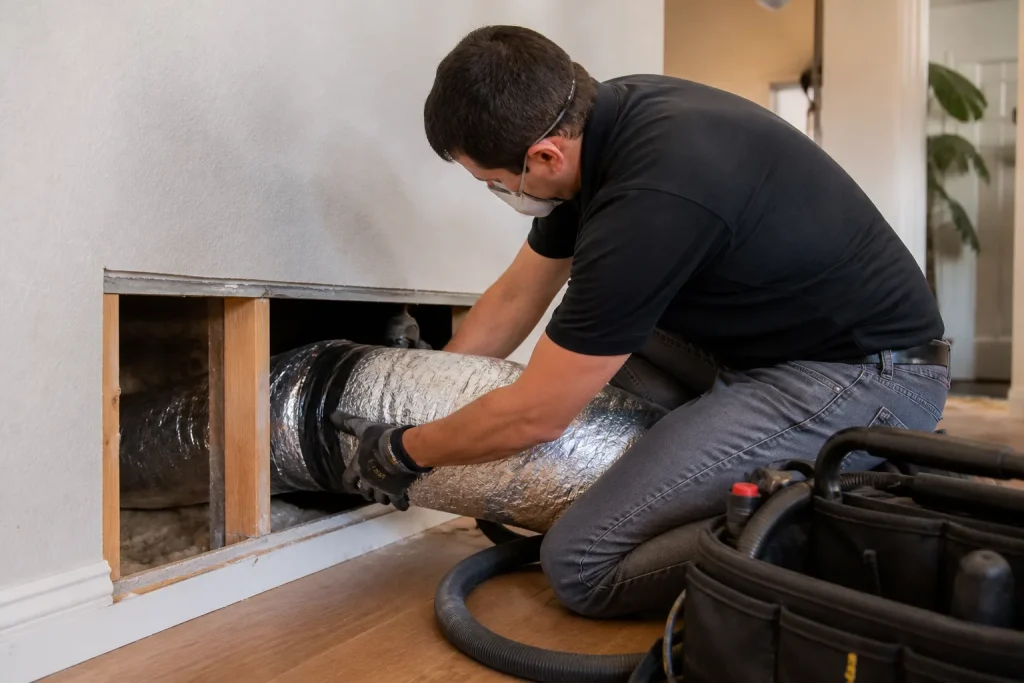
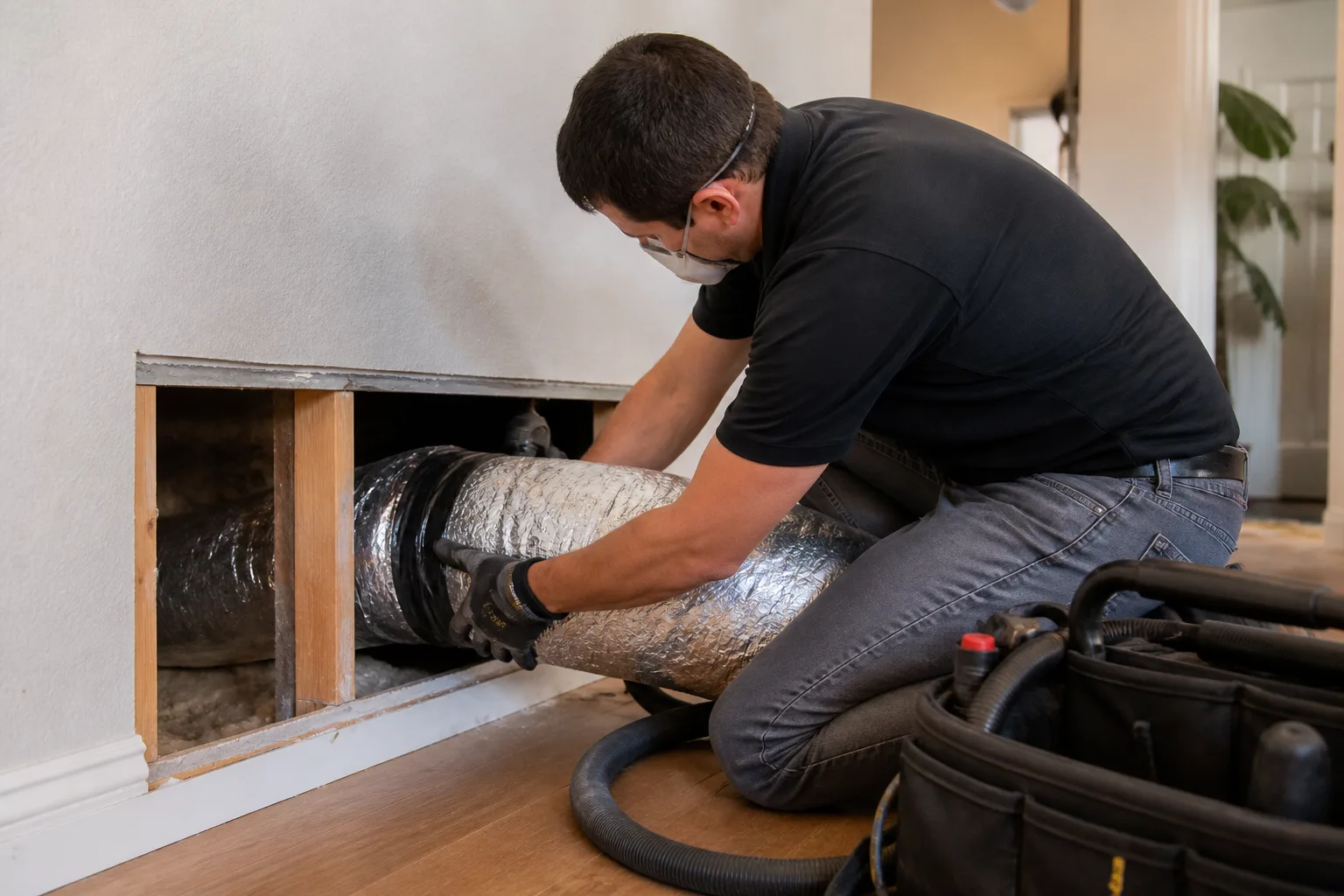
5 Mistakes to Avoid With Duct Sealing
Most duct sealing failures trace back to preparation errors that happen before a drop of mastic or a puff of aeroseal is ever applied. Specifically, skipping the pre-seal cleaning and pressure testing that determine whether the seal will hold. If you’re planning duct sealing in Los Angeles and want the work to actually hold up, avoid these five mistakes. If you’d rather skip the guesswork entirely, call (361) 326-5060 and we’ll walk you through what your system needs.
1. Sealing Over Dirty Duct Surfaces
Sealing dirty or leaking ducts without first measuring the leakage rate is like patching a tire without knowing where the puncture is. The work happens, the problem continues, and neither party can prove the job did anything. Here’s what happens when mastic meets a dusty duct: it peels. Within months, sometimes weeks.
Duct surfaces in Los Angeles collect a fine layer of dust, construction debris, and sometimes oily residue from cooking or past HVAC neglect. Mastic, the thick paste compound used in professional duct sealing, needs a clean, dry surface to bond. If it’s applied over dust, the mastic grips the dust layer, not the metal. When the dust loses adhesion, the seal fails and air leaks return. Foil-backed tape has the same limitation. It sticks to what’s on the surface, not the surface itself.
Proper surface prep means more than a quick wipe. It means removing loose debris, degreasing where needed, and confirming the metal is dry before application. In our experience across Los Angeles homes built from the 1940s through the 1990s, the ducts that hold a seal are the ones that were cleaned first. The Air Duct Cleaning in Los Angeles step is not a separate upcharge. It’s the difference between a seal that lasts five years and one that fails in five months.
What to look for:
- A contractor who inspects the ducts before quoting a sealing price
- Surface cleaning included in the written scope of work
- A written explanation of what prep is being done and why
If a contractor wants to seal without cleaning, that’s a red flag. You’re paying for a seal that’s engineered to fail.
2. Skipping the Pre- and Post-Seal Pressure Test
Here’s the thing most homeowners don’t know: without baseline numbers, you have no way to prove the sealing job worked. A duct blaster test measures how much air is leaking from your system before work begins. The same test run again after sealing shows exactly how much leakage was eliminated. Without both numbers in writing, you’re taking someone’s word for it.
In Los Angeles, where summer cooling loads run hard against leaky attic ductwork, a 20% leakage reduction is a completely different outcome than a 60% reduction. The former might save you pennies. The latter changes your monthly bill. You can’t know which you got without measurement.
We run a duct blaster before and after every sealing job. It’s a calibrated fan that pressurizes the duct system and measures airflow in cubic feet per minute. The baseline tells us where the leaks are concentrated. The post-test tells us the seal actually took. Both numbers go on the job report. You see them. You keep them.
Why this matters in Los Angeles specifically:
- Older duct systems in neighborhoods like West Adams, Silver Lake, and the Valley frequently leak 25% to 40% of conditioned air into attics and crawl spaces
- Without a baseline, a contractor can claim “major improvement” after sealing a single gap
- SMACNA standards for duct leakage testing exist for a reason: unverified sealing is just caulk in the wind
If a contractor quotes duct sealing without mentioning a blower door or duct blaster test, ask why. A professional who stands behind the work measures it twice.
3. Using Duct Tape Where Mastic or Foil-Backed Tape Belongs
The silver cloth tape people call “duct tape” has no business on ductwork. It was never designed for HVAC systems. The adhesive breaks down under attic heat, dries out, and loses its grip. Within a year or two, it’s hanging off the seams like old wallpaper. The name is misleading, and it’s caused more failed seals in Los Angeles attics than any other single mistake.
What actually belongs on sealed duct seams:
- Mastic: a thick paste that’s brushed or troweled onto joints and gaps. It cures to a flexible, airtight seal. Mastic is the industry standard for permanent duct sealing. It resists heat, vibration, and time.
- Foil-backed tape, also called UL 181 tape: a thin aluminum tape with an acrylic adhesive, rated specifically for HVAC use. It’s what you use when a joint needs reinforcement or when mastic alone isn’t practical for a small gap.
- Mastic plus fiberglass mesh: for larger gaps or holes, mesh embedded in mastic adds structural strength so the seal doesn’t crack as the duct expands and contracts.
SMACNA, the Sheet Metal and Air Conditioning Contractors’ National Association, publishes the standards that govern how ductwork gets sealed in commercial and residential systems. Those standards are explicit: duct tape is not an approved material. In Los Angeles, where attic temperatures routinely hit 140°F in summer, the adhesive failure is accelerated. What holds in a mild climate fails fast here.
We use professional-grade mastic and UL 181 foil tape on every Duct Sealing in Los Angeles job. The materials cost more than a roll of cloth tape from the hardware store. The seal lasts a decade or longer. That’s the trade.
4. Sealing Supply Leaks While Ignoring the Return Side
Most homeowners think of duct leaks as air escaping out. That’s the supply side: conditioned air leaking into the attic or crawl space before it reaches the rooms. But the return side matters just as much, and skipping it causes problems that linger long after the job is “done.”
Return ducts pull air from your home back to the HVAC unit. When return ducts leak, they suck air from wherever they sit. If your return runs through the attic, it’s pulling 130°F attic air into the system. If it runs through the garage, it’s pulling car exhaust, paint fumes, and whatever else is out there. That unfiltered air gets pumped through your house.
There’s a pressure problem too. When return-side leaks pull the house into negative pressure, outdoor air gets drawn in through every crack: around doors, windows, recessed lights, and wall penetrations. In Los Angeles, that means wildfire smoke season becomes an indoor air problem even with the windows closed. Your air conditioner works harder. Your filter loads up faster. Dust accumulates quicker.
A proper duct sealing job addresses both sides. The supply side keeps what you paid to condition inside the envelope. The return side keeps what you don’t want outside the system entirely. We seal both, test both, and show the numbers for both on the report.
Signs your return side might be leaking:
- Rooms that stay stuffy even when the AC runs
- Dust accumulation near vents comes back within days of cleaning
- Your system pulls odors from the garage or attic into the living space
- Air handler runs constantly but the house never feels fully cool
If a contractor’s plan covers only the supply side, the job is half done. In Los Angeles, where half the year is spent fighting outdoor heat and smoke, a half-sealed system is a system that still loses.
5. Accepting Work Without a Written Performance Guarantee
Here’s a test: ask any contractor to put their duct sealing guarantee in writing. If they hesitate, you’ve learned something. A contractor who stands behind the work is willing to write down what’s covered, for how long, and what happens if the seal fails.
We publish ours because the standard in this trade is too low. It’s called the 365-Day Done Right Promise, and it applies to every duct sealing job we complete in Los Angeles. If the work fails within a year, we return and make it right at no charge. That includes a free second visit. It’s on paper on every job. It’s not negotiable because it’s not a sales tactic. It’s the operating standard.
What should a written guarantee cover?
- The specific scope of work, including which duct runs were sealed
- The pre-seal and post-seal leakage numbers, in writing
- The guarantee period, stated in days or years, not vague language like “for the life of the system”
- What happens if the seal fails: who comes back, what it costs, and how quickly
- Whether the guarantee transfers if you sell the home
We pulled a failed seal out of a home in Eagle Rock last month where the previous contractor had covered two supply leaks in the attic but skipped the return plenum entirely. The homeowner had a receipt and a verbal promise. No baseline numbers. No post-test. No written guarantee. The fix cost more than the original job because the return leaks had been pulling attic insulation into the system for a year.
When to call a pro: if you’re seeing dust return within days of cleaning, hearing whistling from vents, or facing utility bills that climb every summer, the problem may be in your ductwork. Sealing it properly requires training, the right materials, and measurement equipment. It’s not a caulk gun and a ladder job.
Related services in Los Angeles: Dryer Vent Cleaning in Los Angeles and Duct Sealing in Los Angeles are both part of what we do. If your dryer takes longer than 45 minutes to dry a load, the vent is likely clogged. That’s a fire risk worth addressing sooner than later.
The Bottom Line
Duct sealing fails for predictable reasons: dirty surfaces, skipped testing, wrong materials, ignored return leaks, and no written guarantee. All five mistakes are avoidable, and all five trace back to the same root cause: a contractor who’s willing to cut corners because the homeowner won’t know the difference until the seal fails.
You can avoid all of it by asking for three things before work starts: cleaning included in the scope, pressure test numbers before and after, and a guarantee in writing. If you’re in Los Angeles and want help, Hollis Air Duct Cleaning home is where you’ll find a team that does all three on every job. Call (361) 326-5060 for a free estimate. We’ll inspect your system, explain what we find, and quote you a price in writing before any work begins.
Frequently Asked Questions
Duct sealing in Los Angeles typically runs $800 to $1,800 for a standard single-family home, depending on the number of ducts, the system’s accessibility, and whether we’re sealing the full run or specific problem areas. The price includes cleaning prep, pressure testing, and the written guarantee. Call (361) 326-5060 for an exact quote. Estimates are free.
Duct sealant fails because it was applied to a dirty surface, because the wrong material was used, because return-side leaks were skipped, or because no one tested the system to confirm the seal actually took. All of these are preparation and verification failures, not material failures. A properly prepared and tested seal using mastic or UL 181 foil tape should last ten years or longer.
If rooms heat unevenly, dust returns within days of cleaning, musty or stale odors come from the vents, or your utility bills keep climbing while the AC runs nonstop, your ducts are likely leaking. A duct blaster test will confirm it with hard numbers. We run that test before and after sealing so you see exactly what changed.
Yes. Sealing the ducts before installing new equipment ensures the new system isn’t pushing conditioned air into the attic. A new furnace or AC attached to leaky ducts is like buying new tires for a car with a bent rim. The test and seal are a fraction of the equipment cost, and the efficiency gain compounds for the life of the system. Call (361) 326-5060 and we’ll walk you through the timing.
Written by Roy Castellanos, Owner at Hollis Air Duct Cleaning, serving Los Angeles since 2004.
Need Air Duct Cleaning Help?
Call Hollis Air Duct Cleaning - licensed & insured, here with fast after-hours help in Los Angeles.
(361) 326-5060