
5 Mistakes to Avoid With Dryer Vent Cleaning
Most dryer vent cleaning failures aren’t caused by skipping the job entirely. They’re caused by doing part of the job and calling it done. The U.S. Fire Administration links roughly 2,900 home dryer fires a year to failure to clean, but a lot of those fires happen in homes where someone believed the vent had been cleaned. Here are the five mistakes we see in Los Angeles homes, and what actually needs to happen instead.
If you’d rather not deal with any of this yourself, call Hollis Air Duct Cleaning home at (361) 326-5060 for a free estimate.
Key Takeaways
- Cleaning only from the inside leaves the most dangerous lint deposit, at the exterior cap, untouched.
- A leaf blower or shop vac doesn’t extract lint from a long vent run; it relocates it.
- Vent length and bend count determine whether cleaning alone can make the system safe.
- Reconnecting damaged flexible foil duct after cleaning can leave airflow worse than before.
- Without a post-clean airflow check, you don’t actually know the job worked.
Mistake 1: Cleaning Only From the Inside
This is the mistake behind a lot of the dryer fires that happen in Los Angeles each year. Someone runs a brush or a vacuum hose into the duct from the laundry room side, sees some lint come out, and assumes the vent is clear. It usually isn’t.
Lint doesn’t distribute evenly through a vent run. The heaviest accumulation builds where airflow slows down, which is almost always at the exterior termination cap: the flapper, the screen, or the louvered cover where the duct exits the house. That’s where lint meets outside humidity, clumps, and hardens into a mat that the dryer’s airflow can’t push through. Cleaning from the inside alone never reaches that deposit properly because the cap itself blocks access from the laundry room side.
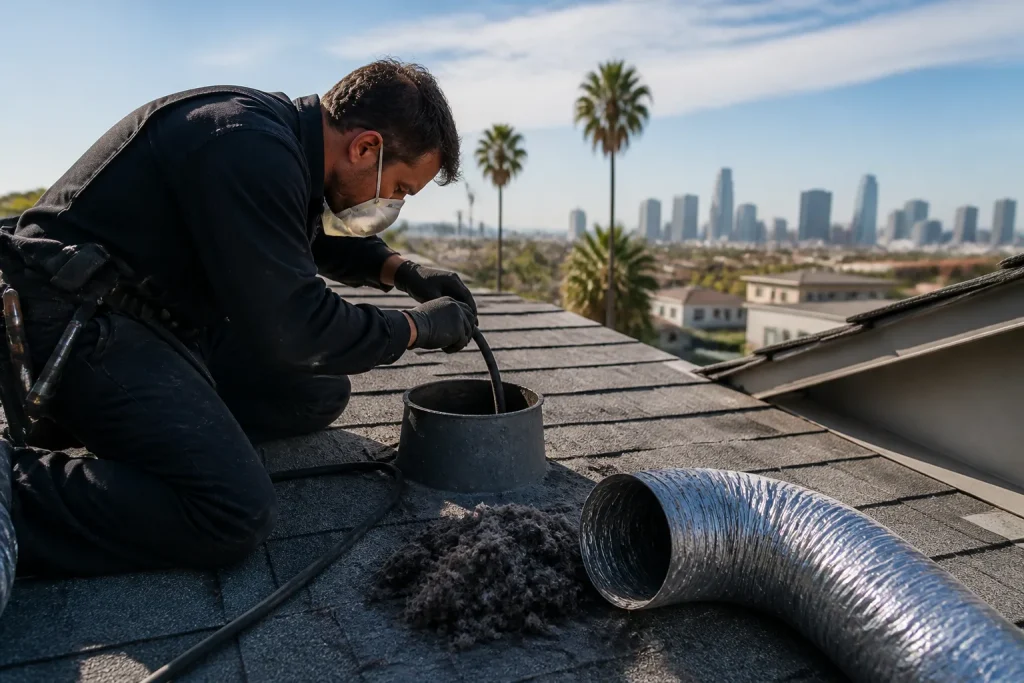
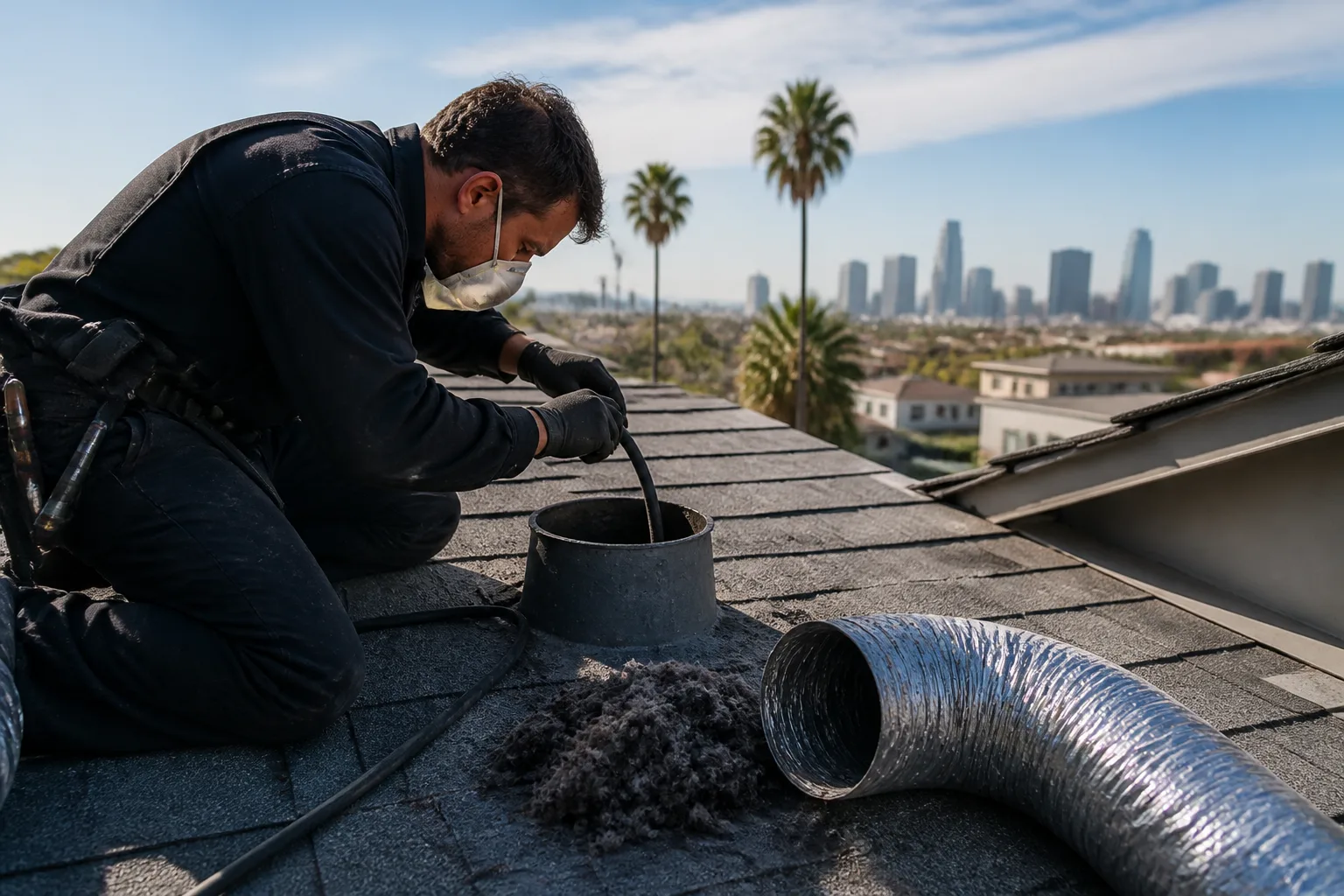
The full job means cleaning the entire run from both directions, from the dryer connection all the way to the exterior cap, and removing the cap itself so the final section gets cleared. If you’re in Los Angeles, where many homes vent through the roof instead of a side wall, that exterior access often means a ladder and a second person. Skipping it means the most fire-prone section of the vent is the part that never got cleaned.
Mistake 2: Using a Leaf Blower or Shop Vac
Someone sees a YouTube video of a person taping a leaf blower to a dryer vent and decides that’s the same as professional cleaning. It is not. A leaf blower pushes air into the duct at high volume. What it doesn’t do is scrape the duct walls. Years of lint in a dryer vent builds up as a caked, layered film, not loose fluff. Compressed air, or a blower, moves the loose debris and leaves the bonded lint exactly where it was.
Worse, the air from a leaf blower can push debris deeper toward a bend or a restriction, packing it tighter. A shop vac has the opposite problem: it has enough suction for the first few feet of duct, but standard 4-inch dryer vents in Los Angeles homes routinely run 15 to 25 feet with multiple bends, often through attics or under slabs. A shop vac doesn’t have the airflow volume or the reach to extract from a run that long. What it pulls out is the easy stuff at the opening. What it leaves is the compacted lint deeper in the line.
The right tool is a rotary brush system like those from Rotobrush or Nikro, paired with a negative-air machine that captures the loosened debris instead of blowing it into the room. The brush physically scrubs the walls of the duct, and the negative air pulls everything out the proper direction. That’s the difference between cleaning and rearranging lint.
Mistake 3: Ignoring Vent Length and Bend Count
Dryer manufacturers publish a limit on how long a vent run should be and how many bends it can have before airflow drops below a safe level. The International Residential Code caps dryer exhaust ducts at 35 feet, with 5 feet deducted for every 90-degree bend. A 25-foot vent with three elbows exceeds the equivalent length limit. In Los Angeles, a lot of older townhomes and condos have vents that run longer than that, often through interior walls, shared chases, or up to a roof cap two stories above the dryer.
Cleaning doesn’t shorten a vent, and it doesn’t remove bends. If the vent is too long or too kinked, even a perfectly cleaned duct still accumulates lint faster than it should because the airflow is too weak to carry it out. And in a condo or a townhome, the vent usually passes through common space, which means a restricted vent isn’t just your problem; it can deposit heat and dryer exhaust where you can’t see it.
This is where Dryer Vent Cleaning in Los Angeles becomes part inspection. The right time to know a vent is too long is not after a fire. In our experience, the best window to check is during the cleaning itself, when the duct is already open and accessible. If your vent run exceeds the manufacturer’s limit, the fix may mean rerouting the duct or separating the transition duct from the hard pipe, not just scheduling the next cleaning a little sooner.
Mistake 4: Reconnecting Damaged Flexible Foil Duct
Here’s a mistake that happens after the cleaning is technically finished. Someone pulls the dryer away from the wall, cleans the vent, pushes the dryer back, and reconnects the existing flexible foil duct without looking at it. The foil duct has a crease from being pinched between the dryer and the wall, or it has a small tear near the clamp, or it’s been compressed from years of the dryer being pushed back too hard. The vent is clean, but the airflow is still restricted.
Flexible foil duct is fragile. It kinks easily, it tears at the connection points, and it shouldn’t be used for anything beyond the short transition between the dryer and the wall connection. In our experience, the most common version of this Los Angeles problem is the dryer sitting in a tight laundry nook where the foil duct gets crushed every time someone shoves the dryer back into place. The dryer runs longer, the dry times creep up, and the clean vent gets blamed.
The fix is part of the job. After cleaning, the transition duct should be inspected, and if it’s kinked, torn, or crushed, it should be replaced with rigid or semi-rigid metal duct, which doesn’t crush the same way and doesn’t trap lint as easily. Reconnecting damaged duct onto a freshly cleaned vent is like putting a used oil filter back on during an oil change. The expensive part was done right; the cheap part undid it.
Mistake 5: Skipping the Post-Clean Airflow Verification
You can’t see lint in the middle of a 20-foot vent. You can’t know the rotary brush actually reached the roof cap or that the negative-air machine pulled the debris out rather than loosening it and leaving it. The only way to confirm the job worked is to check airflow at the exterior termination cap before and after, and to run the dryer briefly at the end to confirm that the cap opens and air moves through it.
We pulled one out of a garage over in Sherman Oaks a while back where the homeowner had paid another company to clean the vent six months earlier. The exterior cap was still crusted with a half-inch layer of packed lint, because the crew had cleaned from the inside, closed up, and left. The homeowner had no way to know. The dryer had been taking 70 minutes per load, and the vent had been “cleaned” twice in the previous two years.
Skipping verification is how you get a receipt instead of a clean vent. A technician who does the job right will show you the airflow at the cap, explain how to know the vent is clear on a future visit, and won’t treat a quick visual check from inside the laundry room as verification. If you’re handling the job yourself, you need to get to the exterior cap and put your hand in front of it while the dryer runs. Real, strong airflow is how you know Air Duct Cleaning in Los Angeles wasn’t just a show.
The Bottom Line
Dryer vent cleaning is not complicated, but it has a right way and a short way. The short way costs less up front and leaves the lint that actually starts fires. The right way means cleaning the full run to the exterior cap, pulling and inspecting the cap itself, using a rotary brush with negative air extraction instead of a blower, checking the vent length against code, inspecting the transition duct for damage, and confirming real airflow at the end.
If you’re in Los Angeles and need help, Duct Sealing in Los Angeles is also available if your vents need more than cleaning. Hollis Air Duct Cleaning offers free estimates and written pricing before any work starts. Call (361) 326-5060. The estimate takes a few minutes, and the price is the price.
Frequently Asked Questions
Dryer vent cleaning in Los Angeles typically runs between $100 and $250 for a standard single-family home with a roof or wall vent. Condos and townhomes with longer vent runs or shared architectural features may run higher. The price should include the full run from dryer to exterior cap, the cap itself, and a post-clean airflow check. Call (361) 326-5060 for an exact quote, and it will be given in writing before work begins.
The low quotes usually mean the crew cleans from the inside only, doesn’t remove the exterior cap, and doesn’t verify airflow afterward. That’s a partial job. A complete cleaning requires tools that scrape the full run, not just a vacuum at the opening. If the price seems too good to include the roof or exterior cap access, it probably doesn’t. Call (361) 326-5060 to get a written quote that covers the full job.
Ask to see airflow at the exterior cap while the dryer runs, or check it yourself if you can reach the cap. Strong, steady airflow is the proof. If the cap was removed and cleaned, you’ll see the difference. A written receipt doesn’t tell you whether the middle of the duct is clear. The best way to avoid the doubt is to hire a company that verifies airflow as part of the job and stands behind the work, which is what our Done Right Promise covers. Call (361) 326-5060 to schedule.
Most homes with a standard vent run under 35 feet need cleaning once a year. Homes with long vents, multiple bends, or rooftop terminations may need it every 6 to 9 months. If your dryer is taking more than one cycle to dry a load, or the exterior flap doesn’t open when the dryer runs, that’s a sign a cleaning is overdue. Call (361) 326-5060 for a free estimate and we’ll tell you what your vent actually needs.
Written by the team at Hollis Air Duct Cleaning.
Need Air Duct Cleaning Help?
Call Hollis Air Duct Cleaning - licensed & insured, here with fast after-hours help in Los Angeles.
(361) 326-5060