
5 Mistakes to Avoid With Air Duct Cleaning
The most expensive air duct cleaning mistakes in Los Angeles are not made by technicians. They’re made by homeowners in the fifteen minutes before they book, when a low teaser price gets accepted without a written scope of work. The fix is simple: ask a short list of questions, refuse verbal pricing, and verify the company will document the job before and after. If you’d rather skip the homework, call us at (361) 326-5060 and we’ll walk you through exactly what we do, what it costs, and what you’ll receive in writing before we touch a single vent.
Mistake 1: Accepting a Price Per Vent Instead of a Price Per Job
Per-vent pricing is how a $79 coupon becomes a $700 invoice. The math is simple, and it’s designed to be obscure until the technician is already inside your home. A company quotes you a low per-vent rate, then counts your registers once the van is parked in your driveway. Most Los Angeles homes have between 10 and 25 vents depending on square footage and layout. At $35 per vent, a 20-vent home is $700. At $25 per vent, it’s $500. The coupon said $79, but the coupon never specified how many vents the price included.
The better question to ask is not “what do you charge per vent” but “what is the total written price for my entire system, including all vents, the main trunk line, and the return?” At Hollis Air Duct Cleaning, the price is written down before any work begins and it does not move at the door. That’s The Garrison Standard. The price you approve is the price you pay, whether your home has 12 registers or 22.
What to ask instead:
- “Is this price for the complete system or per vent?”
- “Will you put the total price in writing before you start?”
- “What happens if your count differs from mine?”
We run a negative-air machine from Nikro on every job, which means the price we quote is for the whole system, not a per-opening estimate that gets revised upward mid-job. In Los Angeles, where floor plans range from 1940s bungalows in Highland Park to large two-story homes in Sherman Oaks, the vent count varies wildly. Your price should be locked before the technician starts counting.
Mistake 2: Skipping the Pre-Cleaning Assessment
A technician who goes straight from the front door to the vacuum hose is skipping the most important part of the job. A proper duct cleaning starts with a visual inspection of the system: the return registers, the supply vents, the blower compartment, the evaporator coil if accessible, and the filter housing. That assessment tells the technician what’s actually in your ducts, whether the contamination is uniform or localized, and whether there’s an underlying problem that cleaning alone won’t solve.
We’ve pulled things out of ductwork in Los Angeles that no amount of vacuuming would have addressed. In one home near Echo Park, the previous owner’s cat had been using a disconnected return as a litter box for what appeared to be a very long time. The ducts weren’t just dusty. They were biologically contaminated. A pre-cleaning assessment caught it before we ran the rotary brush through the system, and it changed the scope of work entirely.
What should a pre-cleaning assessment include?
- A visual check of accessible duct sections with a camera or inspection mirror
- An inspection of the filter, blower motor, and evaporator coil
- Identification of any duct leaks, disconnected sections, or moisture issues
- A written summary of what was found, before any cleaning begins
If a company skips this step, you’re paying for a process, not a result. The Garland Standard requires our technicians to complete the assessment and explain what they found in plain English before the equipment comes out of the van. That’s not optional. It’s the difference between cleaning ducts and actually improving the air moving through your home.
Mistake 3: Not Asking for Before-and-After Documentation
Duct cleaning is one of the few home services where the result is completely invisible after the fact. You can’t see inside your ducts. You can’t verify the work by looking at the vents. If the company doesn’t document the job, you are taking their word for it that anything happened at all.
That’s why before-and-after photos matter. A camera inserted into the ductwork before cleaning shows the actual condition: dust accumulation, debris, mold if present, construction remnants. The same camera after cleaning shows what changed. A legitimate company will provide these photos without being asked. A company that balks at the request is telling you something about how they work.
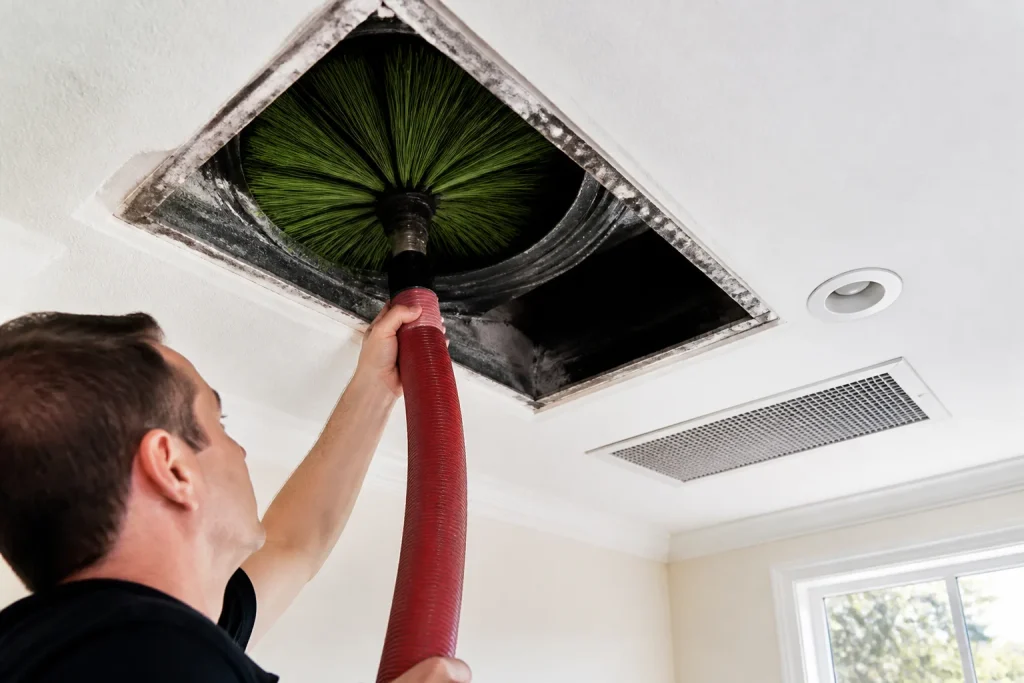
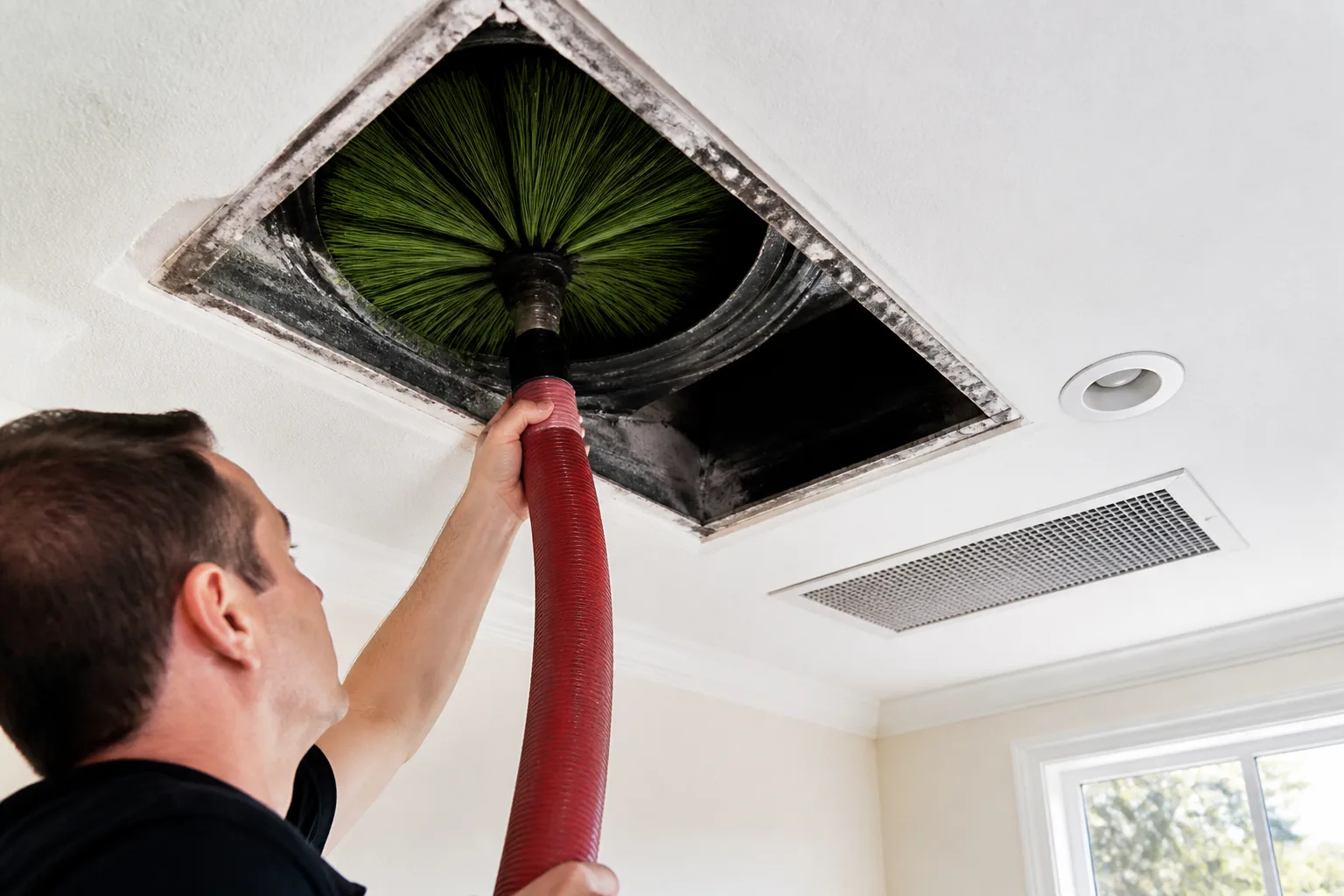
Beyond photos, ask for airflow readings. A Rotobrush rotary brush system paired with a negative-air machine will typically produce a measurable improvement in airflow at the registers, particularly if the ducts were significantly restricted. Static pressure readings before and after can also indicate whether the cleaning made a difference to system performance. These numbers give you something concrete to evaluate.
Ask for:
- Camera photos of the main trunk line before and after
- Photos of at least one return and one supply register before and after
- Airflow or static pressure readings if the system was heavily contaminated
- A written summary of what was removed (dust volume, debris type, any anomalies)
In Los Angeles, where HVAC systems run long hours through wildfire season and dusty conditions, ducts can collect a surprising amount of particulate. You deserve proof the job was done. We give every customer before-and-after photos of their own system because that’s the only way to make an invisible service visible.
Mistake 4: Cleaning Ducts Without Addressing the Contamination Source
If your ducts got dirty once, they’ll get dirty again unless you fix whatever made them dirty in the first place. That’s not a failure of the cleaning. It’s a failure to diagnose the cause.
The most common contamination sources we see in Los Angeles homes:
- A bypassed or undersized filter. If the filter doesn’t seal properly or hasn’t been replaced in months, unfiltered air moves through the system and deposits dust on every surface.
- Duct leaks in the return side. A return duct that pulls air from a dusty attic or crawlspace instead of from the living space will continuously introduce particulate into the system. Cleaning the ducts without sealing the leak is mopping the floor while the roof leaks.
- HVAC drainage problems. A clogged condensate drain or a rusted drain pan creates standing moisture, which invites mold growth in the evaporator coil and the ductwork downstream.
- Construction dust from a recent remodel. Drywall dust, sawdust, and paint overspray get pulled into the ducts during a renovation and stay there until someone removes them.
We use duct sealing mastic from Guardsman to seal accessible leaks, and we’ll tell you plainly if your filter setup is letting dirt through. If the problem is a drainage issue, we’ll point you to an HVAC contractor who can address it. A company that cleans your ducts and says nothing about the visible leak in your return plenum is not doing you a favor. They’re scheduling their own re-cleaning visit in six months.
Here’s the practical test: if your air ducts were cleaned less than two years ago and they already look dirty again, the cleaning wasn’t the problem. The source was never addressed. Fix the source and the next cleaning lasts years instead of months.
Mistake 5: Choosing a Company That Won’t Put Its Guarantee in Writing
Every duct cleaning company on the phone will tell you they stand behind their work. Very few will put it in writing. The difference matters because the failure you’re insuring against usually appears weeks or months after the technician has left, not while they’re still in your home.
A verbal promise dissolves the moment you discover the problem. A written guarantee tells you exactly what happens next. At Hollis Air Duct Cleaning, every job comes with the Done Right Promise in writing. If the work fails within a year, we return and make it right at no charge. That includes a free second visit. No negotiation, no arguing about what was said over the phone. It’s written down before we start.
Here’s what a real guarantee should cover:
- The specific timeframe (days, months, or a full year)
- What constitutes a failure (visible recontamination, unresolved airflow issues, missed sections)
- What the company will do about it (return visit at no charge, re-cleaning, priority scheduling)
- Who to contact and how quickly they’ll respond
If the company won’t write any of this down, keep looking. The Garrison Standard exists because verbal promises in this trade have a poor track record. Written prices, written guarantees, and a technician who arrives in uniform inside the quoted window. That’s not a premium service. That’s the baseline for what you’re already paying for.
And one more thing worth asking: who answers the phone when you call about a problem? We answer with a live person, 24 hours a day, 7 days a week. Not a voicemail queue. Not a call center that takes a message. A person who can look at your file and schedule the follow-up while you’re still on the line. That’s part of what the guarantee is worth.
Related Services in Los Angeles
If you’re researching duct cleaning, you may also need Dryer Vent Cleaning in Los Angeles – clogged dryer vents are a leading cause of house fires, and they need separate equipment and a separate process from your HVAC ducts. If your system is losing conditioned air through leaks, Duct Sealing in Los Angeles addresses the airflow problem at the source. And if you’re ready to get your HVAC ducts assessed, start with Air Duct Cleaning in Los Angeles or visit the Hollis Air Duct Cleaning home page to see our full scope of work.
What happens when you call
- 1
A real person answersNo phone trees - you reach a local pro.
- 2
You get an upfront price rangeHonest numbers before anyone is dispatched.
- 3
A background-checked tech heads outLicensed & insured, dispatched right away.
- 4
You approve before work beginsNothing starts until you say go.
The Bottom Line
The five mistakes that cost Los Angeles homeowners the most money are all preventable in the fifteen minutes before you book. Ask for a written total price, not a per-vent rate. Insist on a pre-cleaning assessment. Require before-and-after photos. Ask what’s causing the contamination, not just whether it can be cleaned. And get the guarantee in writing with a clear explanation of what happens if something goes wrong.
That’s the whole game. There’s no secret technique to evaluate a duct cleaning company. Just a short list of questions and a refusal to accept verbal answers for things that should be written down. If you’re in Los Angeles and want to skip the vetting process, Hollis Air Duct Cleaning will give you a written price before any work starts, document the job before and after, and back everything with the Done Right Promise in writing. Call (361) 326-5060 for a free estimate.
Frequently Asked Questions
For a typical single-family home in Los Angeles with 10 to 20 vents, whole-system air duct cleaning typically runs between $400 and $800 when priced as a complete job. Homes with significant contamination, multiple HVAC systems, or hard-to-access ductwork can run higher. The key is to get a written total price before work starts, not a per-vent rate that changes once the technician counts your registers. Call (361) 326-5060 for a free estimate on your specific system.
The lowest quotes are almost always per-vent teaser prices that don’t cover the full system. The final invoice expands once the technician counts your registers, adds the main trunk line, and introduces fees for things that should have been included. A legitimate company quotes a whole-system price in writing. If the price seems too good to be true and it’s not in writing, it’s not a real price.
Ask for before-and-after camera photos of your ductwork, including the main trunk line and at least one supply and return register. Request airflow or static pressure readings if your system was heavily contaminated. A written summary of what was removed should be standard. If a company won’t provide documentation, choose a company that will.
For most Los Angeles homes, every 3 to 5 years is reasonable if the system has a good filter and no major contamination sources. Homes with pets, recent renovations, wildfire smoke exposure, or HVAC drainage issues may need it more often. If your ducts look dirty again less than two years after a cleaning, the source of contamination wasn’t addressed. Call (361) 326-5060 and we’ll help you figure out what’s actually going on.
Written by the team at Hollis Air Duct Cleaning.
Need Air Duct Cleaning Help?
Call Hollis Air Duct Cleaning - licensed & insured, here with fast after-hours help in Los Angeles.
(361) 326-5060