
Air Duct Cleaning: Repair or Replace? How Los Angeles Homeowners Decide
Most Los Angeles homeowners make the repair-or-replace decision on their ductwork backwards. They get a verbal recommendation from a technician, nod along, and sign off on whatever option is presented first. The smarter approach is to gather three facts before anyone touches a tool: what your ducts are made of, how old they are, and what a duct leakage test actually shows. Those three data points answer the question better than any sales pitch. If you’d rather not sort through it alone, call us at (361) 326-5060 and we’ll walk you through it.
Here’s the opening fact that catches people off guard: flex duct installed in Los Angeles homes before 1990 often has asbestos-containing tape at the joints. That’s not a scare tactic, it’s a testing protocol. Cleaning a system like that without checking first stirs up fibers that should have stayed sealed. This one detail changes the entire conversation from “should I clean or replace” to “what am I actually working with.”
Know Your Duct Material Before You Decide Anything
Los Angeles homes typically have one of three duct types running through attics, crawlspaces, and chases. Each one ages differently, fails differently, and responds to cleaning differently.
- Sheet metal ducts: Galvanized steel, common in homes built before the 1970s. These last 40 to 60 years if the joints hold. Failure mode is usually rust at the seams or separated connections where air leaks into unconditioned space. Sheet metal cleans well and is almost always worth keeping if the structure is sound.
- Flex duct: A wire coil wrapped in plastic and fiberglass insulation. Installed heavily from the 1970s onward, especially in Los Angeles tract housing. Lifespan is 15 to 25 years in a hot attic. The outer liner degrades, the inner liner tears, and the insulation breaks down. By year 20, flex duct in an LA attic is often shedding fiberglass particles into the airstream.
- Duct board: Compressed fiberglass panels formed into rectangular ducts. Common in commercial spaces and some residential retrofits. Lifespan is 20 to 30 years if it stays dry. Once duct board gets wet from condensation or a roof leak, it harbors mold and must be replaced, not cleaned. No amount of brushing fixes water-damaged duct board.
We’ve pulled flex duct out of attics in Van Nuys and Woodland Hills where the inner liner had collapsed to half its original diameter. The homeowner called about weak airflow in one bedroom. The duct wasn’t dirty, it was done. No cleaning pass would have helped. That’s why material identification comes first.
The Duct Leakage Test: The Only Objective Number That Matters
A duct leakage test measures how much conditioned air escapes your duct system before it reaches a vent. A technician seals off the registers, pressurizes the system with a calibrated fan, and reads the airflow loss. The result is expressed in cubic feet per minute at a specific pressure, typically CFM25.
Here’s how to read the number, in plain terms. California’s Title 24 energy code sets a maximum leakage of 6% of the home’s total airflow for new or altered duct systems. A typical 1,500 square foot Los Angeles home moves roughly 1,200 CFM through its system. Six percent of that is about 72 CFM25. Systems that test under that number are tight enough to leave alone. Systems testing at 150 CFM25 or higher are leaking badly, often at multiple locations.
A passing test means cleaning is a reasonable option if the material itself is intact. A failing test means sealing comes first. At Hollis Air Duct Cleaning, we don’t recommend repair or replacement without this number in hand. A verbal “yeah, it leaks a little” doesn’t tell you whether you need two cans of mastic or a full duct swap. The test does.
Seal, Clean, or Replace: The Cost Benchmarks in Los Angeles
Los Angeles pricing for duct work varies by system size, accessibility, and the condition of what’s inside the walls and attic. Here are the ranges we see across the LA market, including the San Fernando Valley, the South Bay, and the Westside.
| Service | Typical Range | When It Makes Sense |
|---|---|---|
| Duct sealing (mastic at accessible joints) | $600 – $1,800 | Leakage test shows moderate loss; ducts are otherwise sound |
| Duct sealing (Aeroseal from the inside) | $1,500 – $3,500 | Leaks are widespread or inaccessible; ducts are in good condition but leaky |
| Partial duct replacement | $1,200 – $3,000 | One or two collapsed flex runs; rest of system tests tight |
| Full duct replacement | $4,000 – $9,000 | Ducts are 20+ years old, degraded, or water-damaged |
| Air duct cleaning | $350 – $750 | System intact, leakage low, contamination is the primary issue |
These are whole-system numbers, not per-vent teaser prices. We write the price down before any work starts, and that price does not move at the door. That’s a Garrison Standard requirement, not a courtesy. If a quote seems too low, ask what’s excluded. Cheap duct work in Los Angeles usually means someone is only addressing the easy sections and hoping you don’t notice the rest.
Key Takeaways
- Identify your duct material first: sheet metal, flex, or duct board. Each has a different lifespan and failure pattern.
- Get a duct leakage test before accepting any repair or replacement recommendation. The CFM25 number is your decision basis.
- Cleaning makes sense when the system tests tight and the problem is dust, debris, or allergens. Cleaning a deteriorated system wastes money.
- Replacement is the right call when flex duct reaches 20+ years in an LA attic, or when water damage or collapsed liners are present.
- Insist on a written price before work begins. If it moves at the door, you’re dealing with the wrong shop.
When Cleaning Alone Makes Sense, and When It Doesn’t
Air duct cleaning in Los Angeles gets a bad name partly because it’s sold as a fix for every HVAC problem. It isn’t. Here’s the honest breakdown of what cleaning does and doesn’t address.
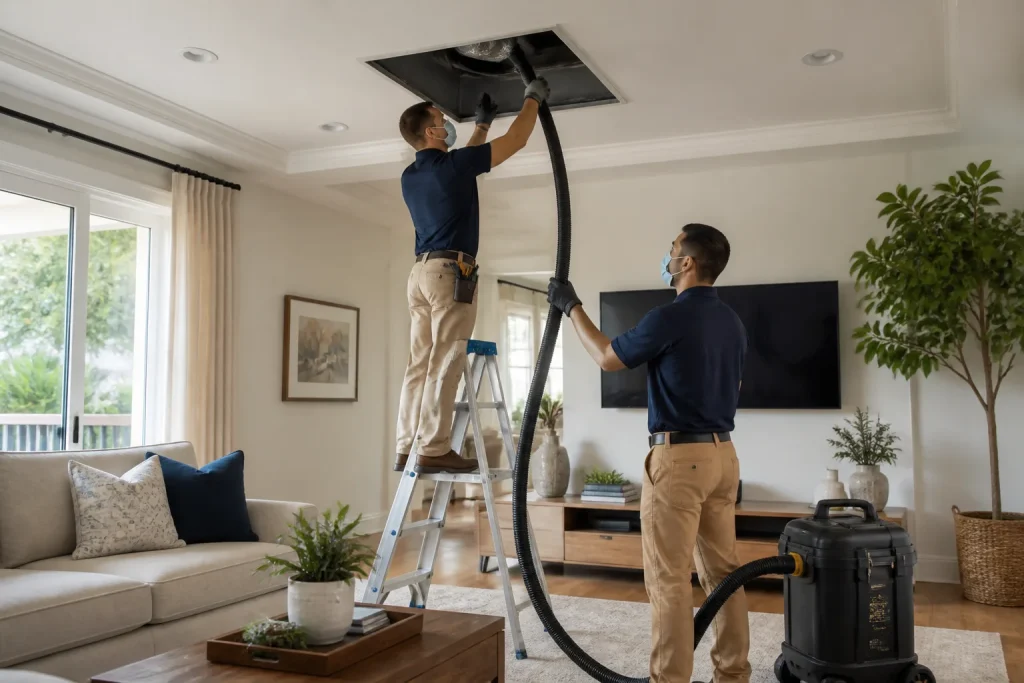
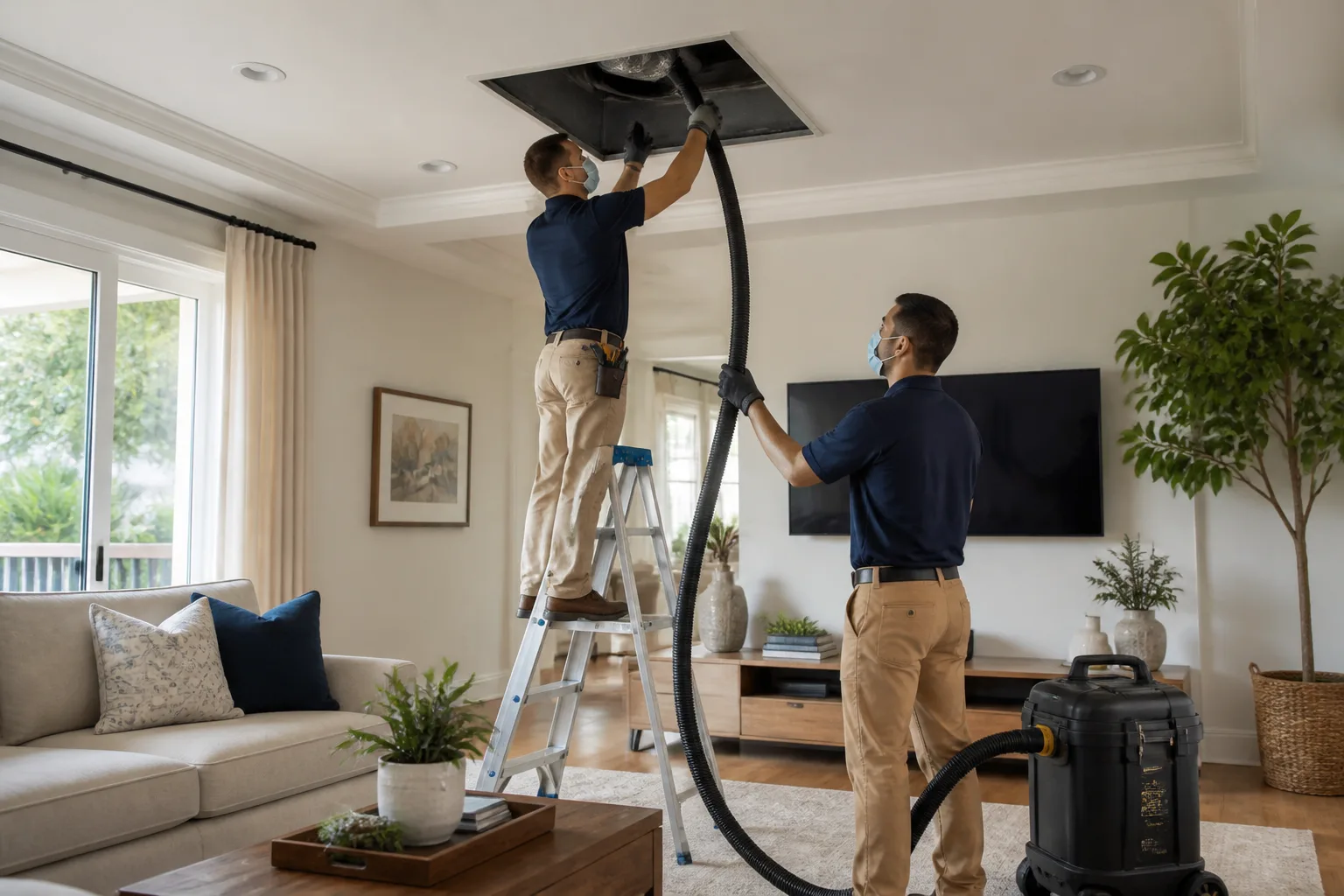
Cleaning is the right call when: the duct material is intact and less than 15 years old, the leakage test comes back under threshold, and the complaint is dust accumulation, pet dander, construction debris, or musty odor from surface buildup. In these cases, a rotary brush system or negative-air setup does what it’s supposed to. We use Rotobrush and Nikro equipment for this work, the same professional-grade tools commercial crews run in LA office buildings and medical spaces.
Cleaning is wasted money when: flex duct has visible tears, the leakage test shows 150 CFM25 or higher, there’s water staining on duct board, or the homeowner reports weak airflow that no filter change fixes. Cleaning a system with collapsed liners is like mopping a floor that’s falling through the joists. The contamination returns because the structure itself is compromised.
One job we did in Pasadena sticks with me. The homeowner had paid for cleaning twice in three years, and the dust kept coming back. We tested the system and found a 10-foot flex run in the attic that had torn completely at the plenum connection. The system was pulling attic air, fiberglass particles, and dust straight into the supply side. We sealed the connection and replaced the damaged run. The dust stopped. The cleaning wasn’t the problem, the duct was.
How the Repair-or-Replace Decision Should Work in Los Angeles
Here’s the sequence we follow at Hollis Air Duct Cleaning, and it’s the same sequence any Los Angeles homeowner should expect from a competent contractor.
- Inspect and identify material. We look at what the ducts are made of, their age, and their condition before recommending anything. This includes checking for pre-1990 flex duct with suspect tape at the joints.
- Run a duct leakage test. We measure actual airflow loss with calibrated equipment. This number tells us whether sealing is sufficient or whether the system has multiple failure points.
- Evaluate contamination separately. Dust and debris inside the ducts are a cleaning question. Water damage, collapsed liners, and degraded flex are a replacement question. The two issues often overlap but should never be confused.
- Write both options down, with prices. If sealing and cleaning will buy you several more years, we price that. If replacement is the honest answer, we price that too. You decide with numbers in front of you, not a verbal recommendation you have to trust.
- Document the work. Before-and-after photos of your own ducts are part of every Hollis job. You see what we saw and what changed. No mystery, no trusting a checklist you never laid eyes on.
That last point matters in Los Angeles more than most markets. Ductwork hides in attics and crawlspaces where homeowners never go. The entire industry runs on that invisibility. Photos close the gap.
For related services in Los Angeles, see our Air Duct Cleaning in Los Angeles and Duct Sealing in Los Angeles pages. If your dryer vent is part of the equation, our Dryer Vent Cleaning in Los Angeles service covers that separately.
What the Done Right Promise Means for Repair Work
Most Los Angeles duct companies have no written guarantee at all. You get a verbal “we’ll take care of you” and a phone number that may or may not connect three months later. Ours is different because it’s written.
The Done Right Promise covers every repair and replacement we perform for a full year. If a sealed joint fails, if a replaced flex run tears, if anything that was serviced doesn’t hold, we come back and make it right at no charge. That includes a free second visit, which most companies in this trade won’t put in writing. The promise is backed by The Garrison Standard, which governs how every Hollis job runs: arrive inside the quoted window, price in writing before work starts, do the job by the book, and leave the site clean.
When you’re weighing repair versus replacement on a system that’s already borderline, the warranty matters. A one-year written guarantee on a $1,500 sealing job means something. A verbal promise on a $7,000 replacement means nothing. Ask for it in writing before you sign. If they won’t put it in writing, that’s your answer about what kind of company you’re dealing with.
The Bottom Line
Repair or replace isn’t a coin flip when you have the right information. Know your duct material. Get a leakage test number. Compare it against the Los Angeles cost benchmarks above. Clean when the system is structurally sound and the contamination is the problem. Seal when leakage is the issue and the ducts have life left. Replace when the flex has aged out, the liner has collapsed, or water damage has set in.
Most Los Angeles homeowners never get the full picture because they’re deciding on a technician’s say-so alone. We think that’s backwards. No pressure, no games, no price that moves at the door.
If you’re in Los Angeles and need help figuring out whether your ducts should be cleaned, sealed, or replaced, call us at (361) 326-5060. Estimates are free, and the price you get on the phone is the price on the invoice. Hollis Air Duct Cleaning home.
Frequently Asked Questions
A duct leakage test gives you the answer. If your system loses more than roughly 6% of its airflow (around 72 CFM25 on a 1,500 square foot LA home), sealing is the first move. If the ducts are 20+ years old, made of degraded flex, or show water damage, replacement is usually cheaper over time than repeated repairs. Call (361) 326-5060 and we’ll run the test and show you the numbers.
Partial replacement of one or two damaged flex runs typically runs $1,200 to $3,000. Full duct replacement for an average LA home ranges from $4,000 to $9,000 depending on system size and accessibility. These are whole-system prices, not per-vent quotes that inflate once work starts.
Rarely. Weak airflow is almost always a mechanical issue: a collapsed flex liner, a torn connection at the plenum, or an undersized return. Cleaning removes surface debris from intact ducts. It does not repair structural damage. If your vents are blowing weak, request a leakage test before paying for cleaning.
Sheet metal ducts routinely last 40 to 60 years. Flex duct in a hot LA attic, where summer temperatures regularly exceed 130 degrees, lasts 15 to 25 years before the inner liner degrades. Duct board lasts 20 to 30 years if it stays dry. Pre-1990 flex duct may also have asbestos-containing tape at the joints that requires testing before any cleaning or removal.
Written by the team at Hollis Air Duct Cleaning.
Need Air Duct Cleaning Help?
Call Hollis Air Duct Cleaning - licensed & insured, here with fast after-hours help in Los Angeles.
(361) 326-5060