
Honeywell Air Duct Cleaning in Los Angeles: A Homeowner’s Guide
If you have Honeywell equipment installed in your HVAC system, duct cleaning isn’t a generic job. A technician who doesn’t identify and bypass your F300 electronic air cleaner before running a high-powered vacuum can destroy the collector cells, and that repair bill will cost more than the cleaning itself. Here’s what Los Angeles homeowners need to know before scheduling.
We’ve been cleaning ducts in LA, and we’ve learned that the homes with Honeywell components are the ones where the quote needs to be the most precise. Before any work starts, we identify what’s installed, factor it into the written price, and then clean around it correctly. If you’d rather skip the details and get a straight answer for your system, call (361) 326-5060 for a free estimate.
Key Takeaways
- Honeywell components like the F300 electronic air cleaner require bypassing before duct cleaning equipment is connected
- Filter replacement and duct cleaning are different services with different schedules
- LA’s wildfire smoke season means Honeywell filtration systems work harder here than in most markets
- A written price should account for every Honeywell component installed, not just the ducts themselves
What Honeywell Components Are Actually in Los Angeles Homes?
Honeywell doesn’t make air ducts. What they do make are the components that sit inside, alongside, and upstream of those ducts. In the Los Angeles market, we regularly see three pieces of Honeywell equipment in homes across the Valley and the Westside: the F300 electronic air cleaner, the HE360 humidifier, and the VisionPRO thermostat. Each one changes how duct cleaning should be performed.
The F300 electronic air cleaner is the big one. It’s a metal cabinet installed at the air handler with charged collector cells inside. Those cells carry voltage. If a duct cleaning technician connects a negative-air machine to the return side without first removing or bypassing the F300, the suction pulls debris into those cells. More importantly, the static pressure change can damage the cell plates or the power supply. We’ve replaced F300 cells in homes from Sherman Oaks to Pasadena where a previous cleaning crew didn’t isolate the unit first.
The HE360 humidifier matters for a different reason. It sits on the supply plenum and introduces moisture into the airstream. During duct cleaning, if the humidifier’s water panel isn’t removed or the damper isn’t closed, cleaning dust gets wet, cakes onto the panel, and then that contaminated moisture gets pushed into ducts for weeks afterward. A tech who knows the equipment shuts it down before starting.
The VisionPRO thermostat seems unrelated, but it isn’t. Many Los Angeles homes have the thermostat wired to the fan, the humidifier, and the ventilation schedule. When duct cleaning equipment changes airflow, the thermostat’s sensors read that as a system fault. A technician who doesn’t understand the wiring can leave a home with locked-out equipment and a blank screen. Before anything runs, the thermostat should be set to a known state, not just switched off.
How Los Angeles’s Climate and Wildfire Smoke Change the Equation
Los Angeles is a dry, dusty market. Our duct systems collect fine silt that blows in from the foothills, off the 405 corridor, and through open windows during the Santa Ana season. Then wildfire smoke arrives, and that particulate load spikes. Homes with Honeywell filtration systems in Pasadena, Altadena, and the San Fernando Valley saw collection cells and media filters loading up far faster during recent fire seasons than the manufacturer’s standard schedule assumes.
Honeywell’s published maintenance schedule for the F300 recommends washing the collector cells every one to three months, depending on use. That schedule was not written for the air quality we saw over Los Angeles during the 2025 fire season. In our experience, homes within five miles of burn zones needed that cleaning cycle compressed to every two to four weeks. The ducts themselves don’t need more frequent cleaning because of smoke, but the filters and cells sitting inside those ducts absolutely do.
This is the distinction that gets lost. A duct cleaning is an event, done every three to five years in most Los Angeles homes. Filter and collector cell maintenance is a recurring task, done monthly or quarterly. The two are not interchangeable, and no honest company should sell a duct cleaning as a substitute for filter maintenance, or a filter change as a duct cleaning. When you call a company for air duct cleaning in Los Angeles, the quote should clarify which service you’re actually paying for.
What to Ask a Duct Cleaning Company About Honeywell Equipment
Before any crew shows up at your Los Angeles home, ask these questions. The answers tell you whether you’re dealing with a crew that understands equipment or a crew that only knows vacuums.
- Do you identify and bypass F300 electronic air cleaners before connecting equipment? The correct answer is yes, and the tech should describe how. If they don’t know what an F300 is, that’s a red flag.
- Do you close the HE360 humidifier damper and remove the water panel before cleaning? The correct answer is yes, every time.
- Do you set the VisionPRO thermostat to a known state before running the negative-air machine? The correct answer is yes, and the tech should know why it matters.
- Is the price for Honeywell component handling included in the written estimate, or is it an add-on at the door? If it’s an add-on, you’re about to experience a moving target.
At Hollis Air Duct Cleaning, the answer to all four is the same: the equipment is assessed before the job is scoped, the written price includes whatever handling your Honeywell components require, and nothing changes when the technician pulls up.
What Happens When Honeywell Components Get Damaged During a Cleaning
The most common failure we see is a cracked or shorted F300 collector cell. Replacement cells for the F300 run several hundred dollars per set, and the power supply is more. If a previous cleaning crew pulled the cells out and dropped them, or ran the system with the high-voltage contact still wet, the homeowner doesn’t discover it until the next filter inspection. The total repair lands in the $400 to $900 range on most Los Angeles jobs, depending on the model and what got damaged.
The second most common issue is a humidifier that’s been left in the wrong state. Water panels that should have been removed get caked with cleaning debris. The panel needs replacing, the drain line gets flushed, and in some cases the solenoid valve fails because debris worked its way in. That’s another hundred to three hundred dollars.
None of this is covered by the duct cleaning company’s standard liability wording unless it’s specifically addressed in writing before the job. That’s the practical reason behind our Done Right Promise. It’s written into every job we do in Los Angeles, not negotiated after the fact.
What a Proper Cleaning With Honeywell Equipment Looks Like
A correct job starts with an equipment assessment. The technician walks the indoor air handler, identifies every Honeywell component, and documents its state before any equipment is powered on. The F300 cells come out carefully, get inspected, and are set aside on a clean surface. The HE360 damper gets closed and the water panel removed. The thermostat gets set to a manual fan-off state so the controls aren’t confused by airflow changes.
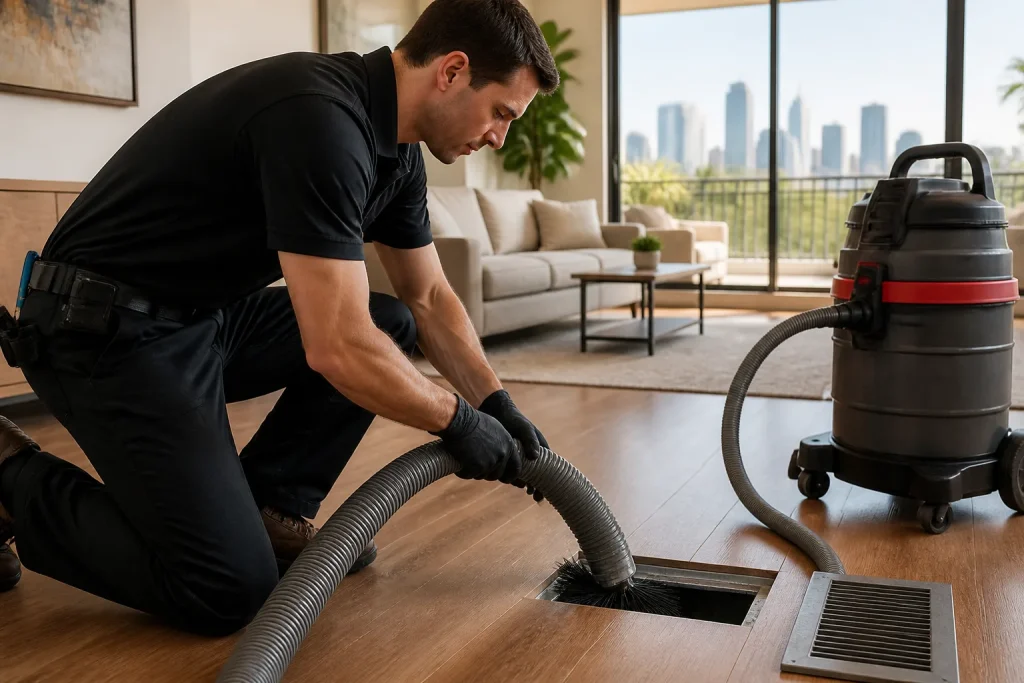
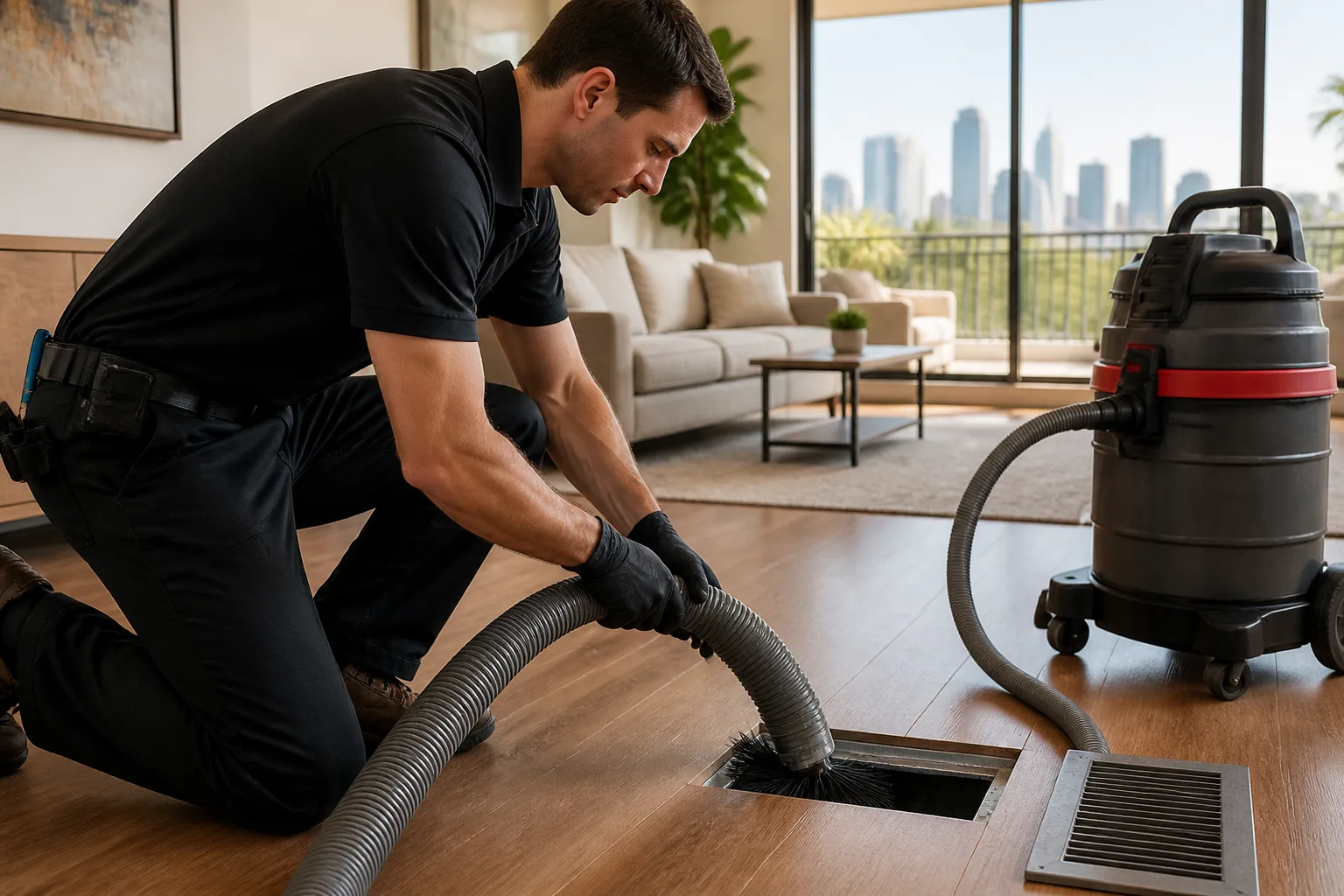
Then the cleaning itself runs with professional-grade equipment. We use Rotobrush rotary brush systems and Nikro negative-air machines, the same tools commercial crews in Los Angeles run on hospital and school duct systems. Not hardware-store gear. The negative-air machine creates negative pressure inside the duct, the brush agitates the walls, and the debris gets pulled into HEPA filtration instead of blowing into the living room.
After the ducts are cleaned, the Honeywell components go back in, get tested, and the thermostat gets returned to its programmed schedule. The written report lists exactly what was cleaned, what was removed, and what state every component was left in. That’s the Garrison Standard: arrive inside the quoted window, price in writing, complete the job by the book, leave the site clean.
When to Call a Pro for Honeywell and Duct Issues
You should call a professional when you see dust on the registers after the system has just run, when a musty odor comes through the vents every time the fan starts, or when the Honeywell filter indicator is going off faster than the schedule suggests. In Los Angeles, those indicators often mean the ducts themselves are the source, not just the filter. If you’re in a neighborhood like Encino, Tarzana, or Studio City and the air feels heavy even after a filter change, that’s a duct problem, not a filter problem.
Related services for Los Angeles homeowners: if your dryer vent is pushing lint past the exterior flap, the dryer vent cleaning in Los Angeles page covers that separately. And if your ducts are run through an unconditioned attic where the metal has separated at the seams, duct sealing in Los Angeles is the fix, not more cleaning. Both are different jobs, and both should be priced in writing before work starts.
We pulled an old Aprilaire filter housing out of a house in Valley Village last year where the homeowner had been told by another company that “the filter is fine, you just need a duct cleaning.” The filter had collapsed into the duct itself and was blocking nearly half the return airflow. The ducts were dirty because the failed filter had been spreading debris through them for months. The fix was a new housing, a fresh filter, and a proper cleaning, not a vacuum over the problem.
The Bottom Line
Honeywell makes good equipment. But that equipment has to be handled correctly during duct cleaning, or the cleaning costs more than it should. In Los Angeles, where wildfire smoke and dry silt put extra load on filtration systems, the margin for error is thin. Ask the right questions, get a written price that includes Honeywell component handling, and don’t let anyone treat a filter change as a duct cleaning.
If you’re in Los Angeles and you want a crew that already knows the Honeywell hardware in your system, Hollis Air Duct Cleaning offers free estimates. Call (361) 326-5060 and ask for a written price. You’ll get one before any work starts.
Frequently Asked Questions
How do I know if I have Honeywell components in my HVAC system? Look at the air handler, which is usually in a closet, attic, or garage in most Los Angeles homes. Honeywell labels their metal cabinets clearly, with the model number on a sticker. An F300 electronic air cleaner is a gray or tan cabinet about eight inches thick, mounted between the return duct and the air handler. The thermostat on the wall with “VisionPRO” printed on the face is another tell. If you’re not sure, call us and we’ll identify what you have during the estimate.
Does Honeywell make air ducts, or just components? Honeywell does not manufacture ductwork. They make filtration systems, thermostats, humidifiers, and dampers that install inside or adjacent to the ducts. That’s why “Honeywell air duct cleaning” really means cleaning the ducts in a system where Honeywell equipment is present, and handling that equipment correctly during the job.
How often should Los Angeles homeowners clean their ducts versus change Honeywell filters? Duct cleaning is typically needed every three to five years in Los Angeles, more often if you’ve had construction, pets, or heavy wildfire smoke exposure. Honeywell filter changes are far more frequent: monthly to quarterly for media filters, and every one to three months for F300 electronic air cleaner cell washes. If you’re changing filters more often than the schedule and they’re still dirty, that points to a duct problem. Call (361) 326-5060 and we can tell you which one you actually need.
Can duct cleaning damage my Honeywell equipment? Yes, if the company doesn’t know what they’re doing. The biggest risks are to the F300 electronic air cleaner, which can be damaged by suction or static pressure changes during cleaning. A technician who bypasses and removes the cells first, closes the humidifier damper, and sets the thermostat to a known state will avoid those problems. At Hollis Air Duct Cleaning, the equipment assessment is part of the written quote, not an afterthought.
Written by the team at Hollis Air Duct Cleaning.
Need Air Duct Cleaning Help?
Call Hollis Air Duct Cleaning - licensed & insured, here with fast after-hours help in Los Angeles.
(361) 326-5060